Primary source · Koine Greek
The Epistle of Barnabas
Attributed to Barnabas the apostle (authorship debated in antiquity) · c. AD 70–132

What this text is
A fierce, allegorical reading of the Old Testament — circumcision of the heart, the scapegoat as figure of Christ, and its own Two Ways teaching parallel to the Didache.
Profile of Barnabas of Cyprus →
Interlinear passages
Word-for-word glosses of the original; the complete public-domain translation is linked below.
Chapter 18.1 — The two ways of teaching
ὉδοὶWaysδύοtwoεἰσὶνthere areδιδαχῆςof teachingκαὶandἐξουσίας,of authorityἥthe oneτεbothτοῦof theφωτὸςlightκαὶandἡthe oneτοῦof theσκότους.darkness
Public-domain translations
Kirsopp Lake (1912)
There are two Ways of teaching and power, one of light and one of darkness. And there is a great difference between the two Ways; for over the one are set the light-bringing angels of God, but over the other the angels of Satan.
Roberts–Donaldson (ANF, 1885)
There are two ways of doctrine and authority, the one of light, and the other of darkness. But there is a great difference between these two ways.
Manuscript witnesses
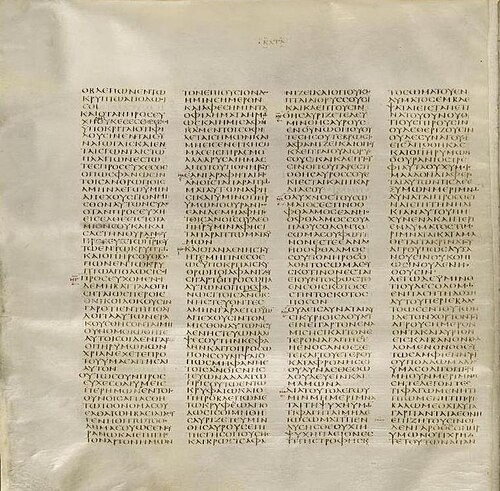
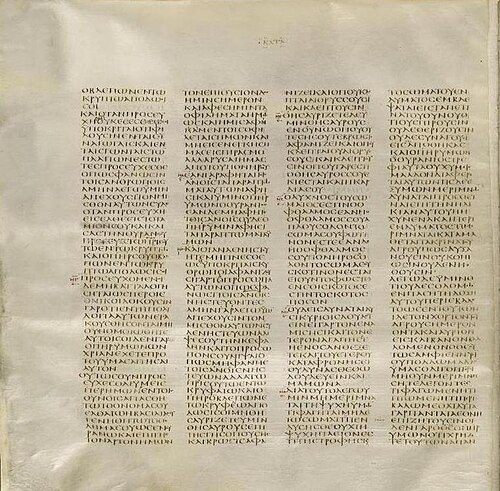
Codex Sinaiticus (British Library)
4th c.Barnabas follows Revelation in the great fourth-century Bible — scripture-adjacent standing made visible.
Codex Hierosolymitanus 54
AD 1056The Bryennios codex's copy, independent of Sinaiticus.
Latin version (Petropolitanus Q.v.I.39)
9th c. copy of an ancient translationAn old Latin of chapters 1–17.
Provenance
Alexandria (probably), c. AD 70–135
Editions & scholarship
Critical editions and standard translations behind the text above.
- Épître de Barnabé (SC 172)P. Prigent & R. A. Kraft, 1971Critical edition with French translation.
- The Apostolic FathersMichael W. Holmes, 3rd ed. 2007Standard text and translation.