The Apostolic Age · AD 4–70
Elizabeth, mother of John the Baptist
fl. c. 5 BC (death unrecorded) · Of the daughters of Aaron · Kinswoman of Mary · the hill country of Judaea
The Apostolic Age


Who Elizabeth, mother of John the Baptist was
Of priestly descent on both sides — Luke says she was of the daughters of Aaron — and, with Zacharias, righteous before God and childless into old age. **The first person in the New Testament to name Mary blessed, and the first to call the unborn Christ Lord.** When Mary came to the hill country, Elizabeth was filled with the Holy Ghost and said what the church has repeated ever since: “Blessed art thou among women, and blessed is the fruit of thy womb.” The second half of the Hail Mary is her sentence, not Gabriel’s.
She is also the one who holds the line on the name. At the circumcision the neighbours and kinsfolk assume the child will be Zacharias after his father; Elizabeth says he shall be called John, and is contradicted on the ground that no one in the family bears it — until the mute Zacharias writes the same name and his speech returns.
Luke calls her Mary’s συγγενίς, a kinswoman, without saying how; “cousin” is the King James rendering rather than a statement of the degree. Since she was of Aaron and Mary of the house of David, the relation implies a tie between the priestly and royal lines, but Scripture does not spell it out and the archive does not fill the gap.
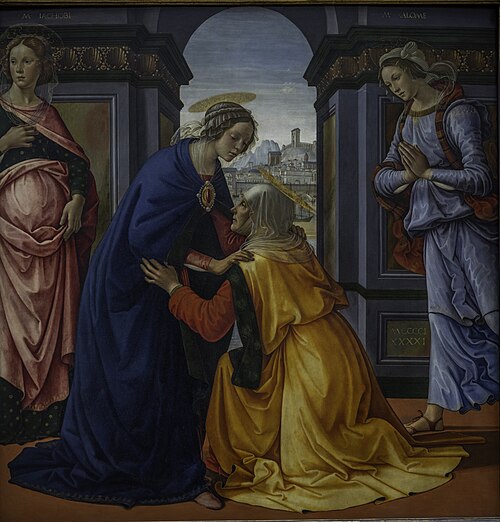
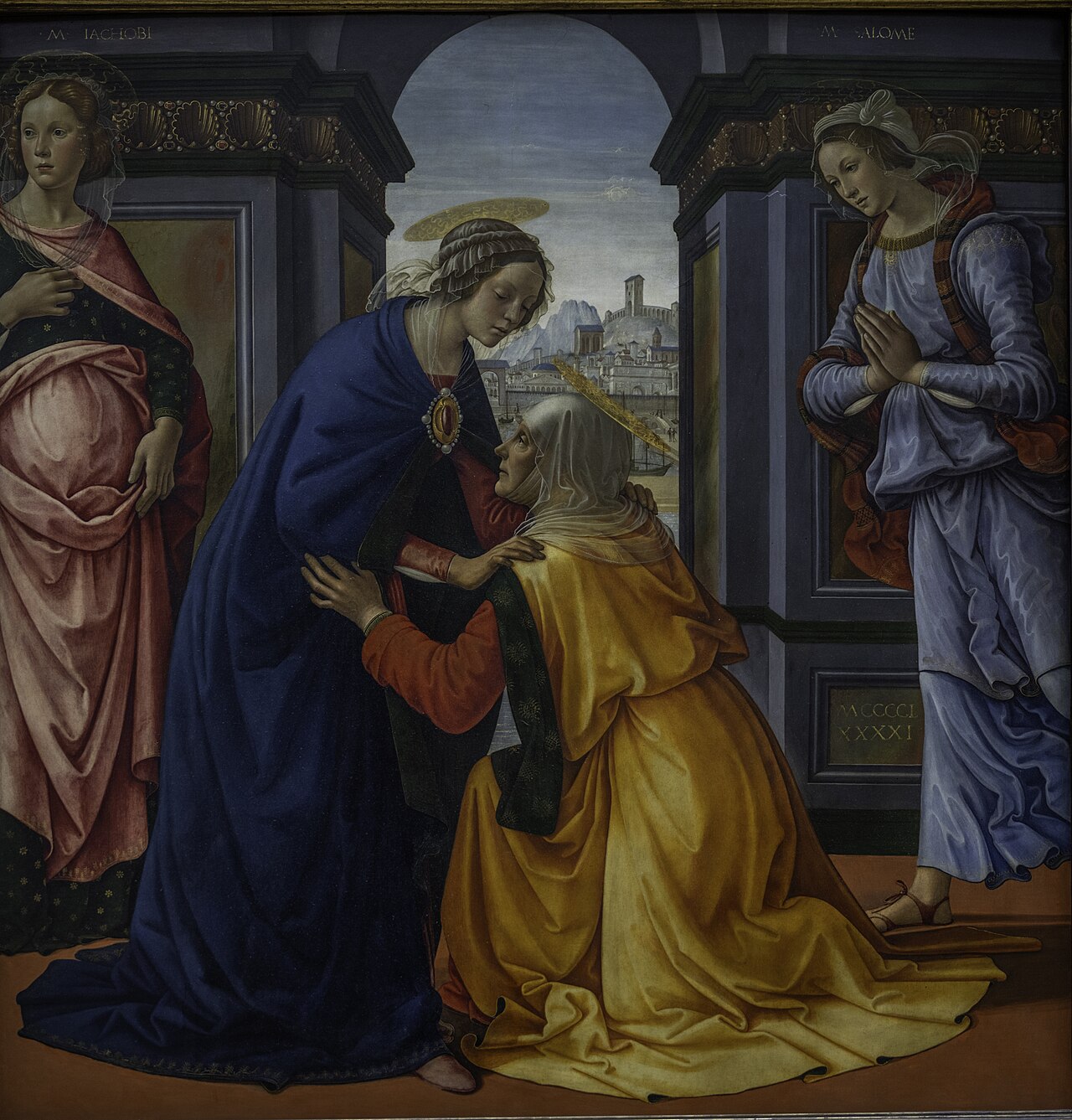
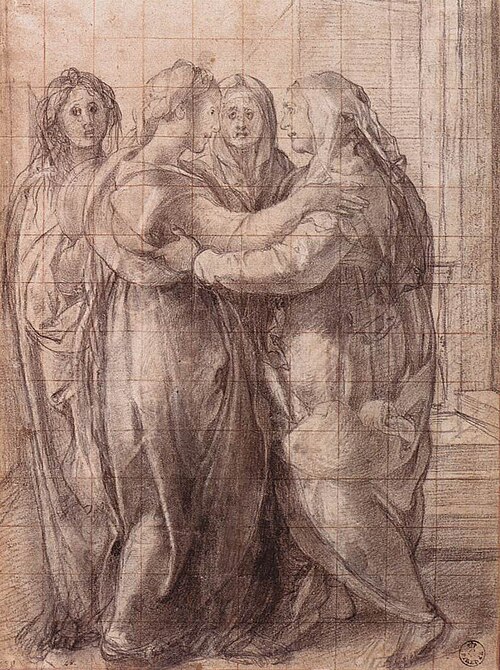
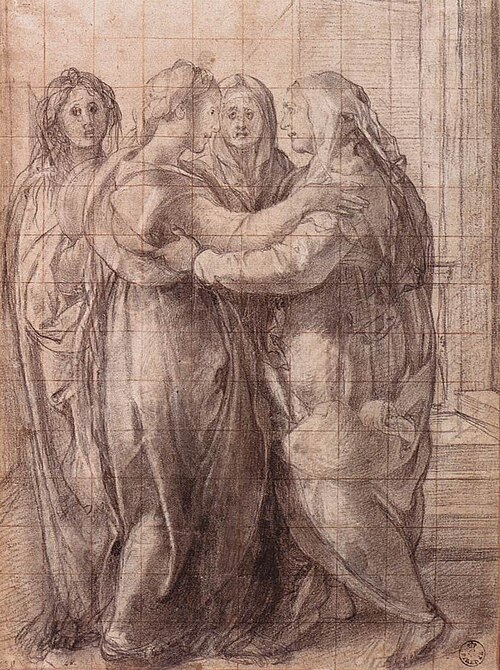
**She is among the most-depicted women in Christian art**, and always in the same scene. The Visitation — the moment of Luke 1:41, Elizabeth recognising Mary — is a subject in its own right with its own feast, and Wikimedia Commons holds an entire category of paintings of it. Two are shown here: **Domenico Ghirlandaio’s Visitation** of 1491, tempera on panel, commissioned by Lorenzo Tornabuoni and now in the Louvre, in which Elizabeth kneels in a wide yellow vest to pay homage to Mary; and **Jacopo Pontormo’s Visitation** of about 1528–30, the Mannerist altarpiece in the Pieve di San Michele at Carmignano, in which the two women embrace in profile with interlinked arms.
Nothing further about her life is recorded. The *Protoevangelium of James* adds that when Herod’s men came for the infant John she fled with him into the hill country and, finding nowhere to hide, cried out to the mountain, which opened and received them both — a later legend, and marked as one.
Also listed in women.
Common questions
When was Elizabeth, mother active?
Elizabeth, mother of John the Baptist is dated fl. c. 5 BC (death unrecorded) in the archive, which places Elizabeth, mother in the Apostolic Age (AD 4–70). The dating is traditional and approximate; the archive marks it as uncertain rather than fixing a year the sources do not give.
Which early sources mention Elizabeth, mother?
Elizabeth, mother of John the Baptist is named in 3 primary-source passages catalogued here, drawn from Luke and Anonymous. Every passage is quoted from a named public-domain translation, earliest first.
Where was Elizabeth, mother from?
The archive associates Elizabeth, mother of John the Baptist with the hill country of Judaea.
Who were Elizabeth, mother’s contemporaries?
The archive links Elizabeth, mother of John the Baptist to 3 other figures, including Zacharias the Priest, John the Baptist and Mary, the Mother of Jesus. Each connection is drawn from a source that places them together, not from inference.
Scripture record
Primary-source mentions (3)
Every passage below is quoted from a named public-domain translation, earliest first.
Luke 1:41–45
c. AD 1And it came to pass, that, when Elisabeth heard the salutation of Mary, the babe leaped in her womb; and Elisabeth was filled with the Holy Ghost: and she spake out with a loud voice, and said, Blessed art thou among women, and blessed is the fruit of thy womb. And whence is this to me, that the mother of my Lord should come to me? … And blessed is she that believed: for there shall be a performance of those things which were told her from the Lord.Luke · read ↗
Luke 1:57–63
c. AD 1And it came to pass, that on the eighth day they came to circumcise the child; and they called him Zacharias, after the name of his father. And his mother answered and said, Not so; but he shall be called John. And they said unto her, There is none of thy kindred that is called by this name.Luke · read ↗
The Protoevangelium of James
c. AD 150[Herod, having ordered the killing of the children, searches also for John. Elizabeth takes the infant and goes up into the hill country, looking for somewhere to hide him and finding none. She cries out to the mountain of God to receive mother and child, and the mountain is rent and receives them, a light shining through it and an angel of the Lord keeping them. The episode is not in Luke and is marked in this archive as later legend; it is the origin of the hill-country cave venerated at Ein Karem and of the mountain-cleft motif in Byzantine painting of the Innocents.]Anonymous · Protoevangelium of James 22 · source text
The Protoevangelium of James, c. AD 145–160 — held in this library. English: Alexander Walker, Ante-Nicene Fathers 8 (1886), public domain. Text verified identical across New Advent, the Christian Classics Ethereal Library (Schaff, ANF08), and two further carriers. Schaff records a variant at this point: “Another reading is: And was rent from the top, etc.”