The Apostolic Age · AD 4–70
Mary, the Mother of Jesus
d. c. 41–48 (traditions vary) · Mother of the Lord · Nazareth → Jerusalem (or Ephesus)
The Apostolic Age
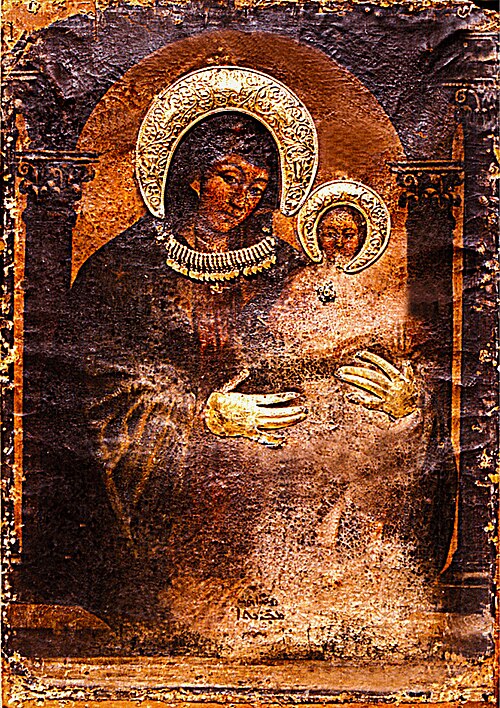

Who Mary, the Mother of Jesus was
After the ascension Mary appears once more in the church’s story, praying in the upper room “with the women, and with his brethren” — her last appearance in the New Testament narrative, and the seal of her place within the first community. From the cross John had received her “unto his own home.” The ancient traditions of her end divide: the older Jerusalem tradition places her dormition there, where the tomb-church at Gethsemane was venerated from early times; a second tradition, following John’s later residence, locates her final years at Ephesus. Neither the year nor the place was fixed in the earliest sources — the silence itself is ancient.
Also listed in women.
Common questions
When did Mary, die?
Mary, the Mother of Jesus is dated d. c. 41–48 (traditions vary) in the archive, which places Mary, in the Apostolic Age (AD 4–70). The dating is traditional and approximate; the archive marks it as uncertain rather than fixing a year the sources do not give.
Which early sources mention Mary,?
Mary, the Mother of Jesus is named in 5 primary-source passages catalogued here, drawn from Luke, Ignatius of Antioch, The Protoevangelist and Justin Martyr. Every passage is quoted from a named public-domain translation, earliest first.
Where was Mary, from?
The archive associates Mary, the Mother of Jesus with Nazareth, Jerusalem (or Ephesus). The sources record more than one location, so the places are listed in the order the record moves through them.
Who were Mary,’s contemporaries?
The archive links Mary, the Mother of Jesus to 18 other figures, including John the Apostle, James the Just, Jude, the Brother of the Lord and Saint Anne. Each connection is drawn from a source that places them together, not from inference.
Scripture record
Primary-source mentions (5)
Every passage below is quoted from a named public-domain translation, earliest first.
Acts 1:14
c. AD 85These all continued with one accord in prayer and supplication, with the women, and Mary the mother of Jesus, and with his brethren.Luke · read ↗
To the Ephesians 19.1
c. AD 108And hidden from the prince of this world were the virginity of Mary and her child-bearing and likewise also the death of the Lord — three mysteries to be cried aloud.Ignatius of Antioch · 19.1 · source text
Protoevangelium of James (her birth, childhood, and virginity)
c. AD 150And the priest received her, and kissed her, and blessed her, saying: The Lord has magnified thy name in all generations. In thee, on the last of the days, the Lord will manifest His redemption to the sons of Israel.The Protoevangelist · Protoevangelium 1–20 · source text
Dialogue with Trypho 100 (the Eve–Mary parallel)
c. AD 160He became man by the Virgin, in order that the disobedience which proceeded from the serpent might receive its destruction in the same manner in which it derived its origin.Justin Martyr · Dialogue 100 · source text
Against Heresies III.22.4
c. AD 180The knot of Eve's disobedience was loosed by the obedience of Mary.Irenaeus of Lyon · Against Heresies III.22.4 · source text
Connected in the archive
People
- John the Apostle
- James the Just
- Jude, the Brother of the Lord
- Saint Anne
- Mary Magdalene
- Mary of Bethany
- Clopas (Cleopas?)
- Joseph the Carpenter
- Joseph of Arimathea
- Zacharias the Priest
- Elizabeth, mother of John the Baptist
- Mary of Clopas
- Joses, brother of the Lord
- Simon, brother of the Lord
- Herod the Great
- Jesus of Nazareth
- Simeon the God-Receiver
- Anna the Prophetess
Named alongside Mary, in the sources
This figure is placed with Mary, by the record — in a council roll, a martyr-act, a letter or a history — without Mary, naming them in return.
Events in this lifetime
- AD 30 · Crucifixion, Resurrection and Pentecost, AD 30–33
- AD 44 · Persecution under Herod Agrippa I, AD 44
Place
Places served
The 2 places the sources put Mary,, in the order the record moves through them. This is what the sources attest, not a reconstructed route.