Primary source · Latin
On the Unity of the Catholic Church (De Ecclesiae Unitate)
Cyprian of Carthage · c. AD 251
What this text is
Cyprian’s appeal for unity against the twin schisms of Novatian at Rome and Felicissimus at Carthage — the founding treatise of the Latin doctrine of the church, written out of the wreckage of the Decian persecution.
Profile of Cyprian of Carthage →
Interlinear passages
Word-for-word glosses of the original; the complete public-domain translation is linked below.
Chapter 6 — The Church as mother
HabereTo haveiamnownonnotpotestcan heDeumGodpatrem[for] fatherquiwhoecclesiamthe Churchnonnothabethasmatrem.[for] mother
Public-domain translations
R. E. Wallis (ANF, 1886)
He can no longer have God for his Father, who has not the Church for his mother. …The spouse of Christ cannot be adulterous; she is uncorrupted and pure.
Benson / traditional rendering
He cannot have God as a father who does not have the Church as a mother. If any one could escape who was outside the ark of Noah, then he also may escape who shall be outside the Church.
Manuscript witnesses
Early Cyprianic codices (Veronensis line)
6th–9th c.De unitate ch. 4 survives in two ancient forms — the 'primacy text' and the 'received text' — both circulating early.
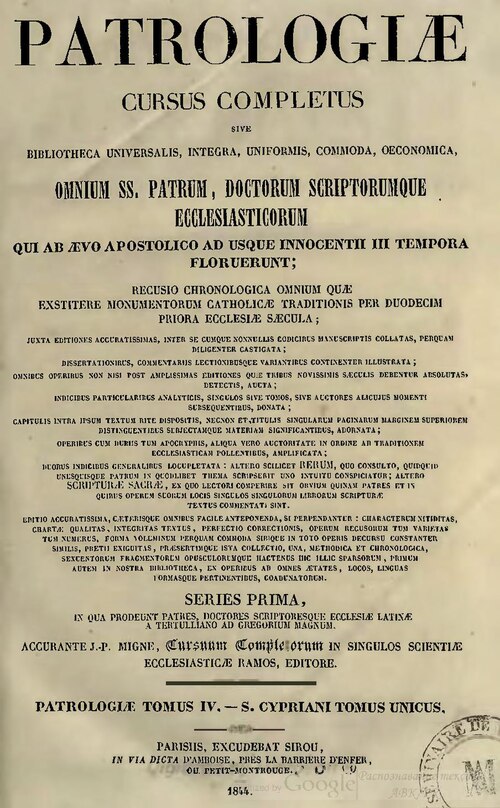
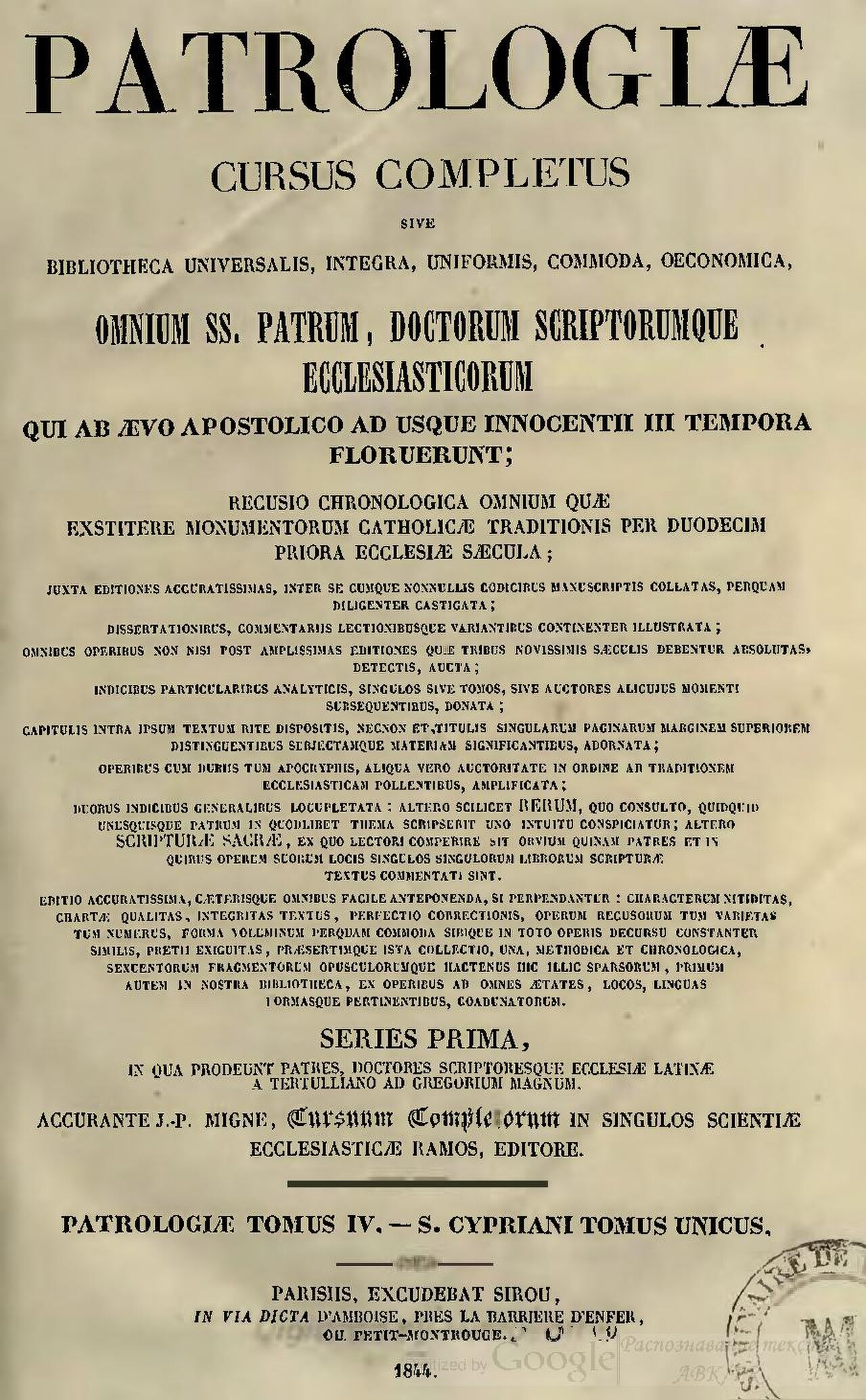
Patrologia Latina, vol. 4 (Migne)
1844Standard pre-critical text of the corpus.
Provenance
Carthage, AD 251, amid the lapsed crisis and the Novatianist schism
Editions & scholarship
Critical editions and standard translations behind the text above.
- De lapsis and De ecclesiae catholicae unitate (OECT)Maurice Bévenot, 1971The critical edition of both treatises with translation.
- Cyprian the BishopJ. Patout Burns, 2002The standard modern study of the crisis years.