Primary source · Gothic (alphabet of his own devising)
The Gothic Bible of Ulfilas
Ulfilas (Wulfila) and his school · c. AD 350–383

What this text is
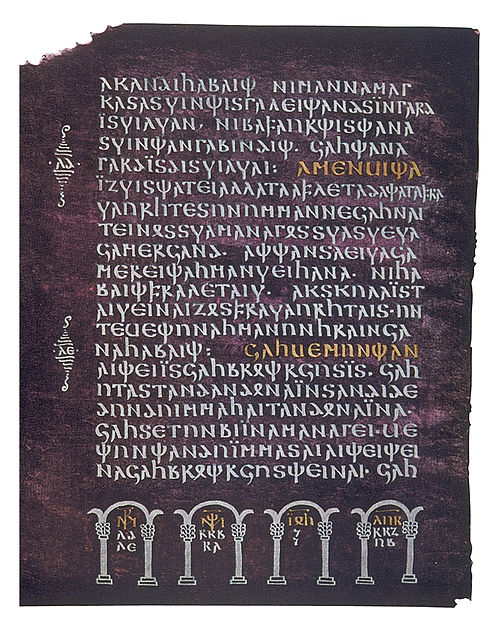
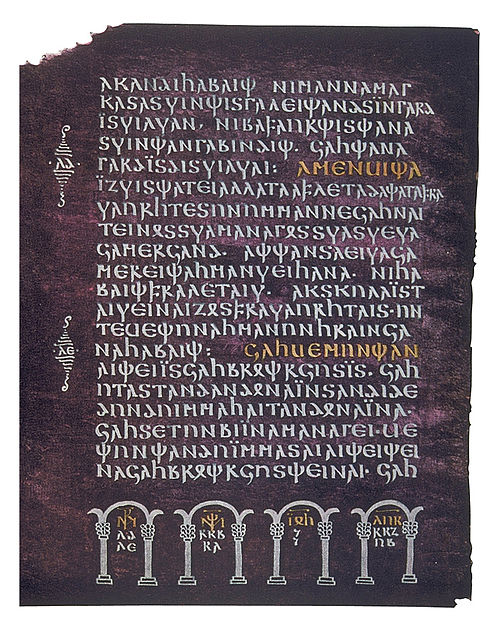
Ulfilas invented an alphabet and translated the scriptures for his people — omitting, says Philostorgius, the books of Kings, 'lest they inflame a war-loving nation'. The wreck of the version is glorious: the silver-and-gold Codex Argenteus, war-booty of 1648, now at Uppsala. TRAGEDY & RECOVERY: of its original 336 leaves, 187 survive — and the 188th, the famous 'Speyer leaf', surfaced in a cathedral archive in 1970.
Profile of Ulfilas (Wulfila) →
Public-domain translations
Working translation (Gothic, ed. Streitberg)
Atta unsar þu in himinam, weihnai namo þein. — Our Father, thou in the heavens, hallowed be thy name. (Matthew 6:9, the Gothic Lord's Prayer)
Manuscript witnesses
Codex Argenteus (Uppsala University Library)
c. AD 520 (Ravenna)Silver and gold ink on purple parchment, made for the Ostrogothic court — carried from Prague as war-booty in 1648; 187 of 336 leaves survive.
The Speyer leaf
c. AD 520; found 1970The Argenteus's final leaf of Mark, discovered in the Speyer cathedral archive thirteen centuries adrift.
Codex Carolinus (Wolfenbüttel)
6th–7th c., palimpsestGothic-Latin bilingual leaves of Romans, recovered from under later writing.
Streitberg, Die gotische Bibel
1908The standard text of all surviving fragments.
Provenance
Gothia beyond and below the Danube; the first Bible in a Germanic tongue
Editions & scholarship
Critical editions and standard translations behind the text above.
- Die gotische BibelWilhelm Streitberg, 1908 (rev. 2000)Critical edition with Greek facing text.
- The Goths in the Fourth CenturyPeter Heather & John Matthews, 1991Sources in translation, including the Ulfilas dossier — secular-critical frame.