Primary source · Latin
The Edict of Thessalonica (Cunctos populos)
Emperors Gratian, Valentinian II & Theodosius I · 27 February AD 380

What this text is
The constitution that made Nicene Christianity the religion of the Roman state — all peoples to hold the faith 'which the divine apostle Peter delivered to the Romans,' as kept by Damasus and Peter of Alexandria.
Interlinear passages
Word-for-word glosses of the original; the complete public-domain translation is linked below.
Codex Theodosianus XVI.1.2 — the opening
CunctosAllpopulos,peoplesquoswhomclementiaeof clemencynostraeourregitgovernstemperamentumthe rule
Public-domain translations
Literal gloss of the Latin
It is our will that all the peoples whom the rule of our clemency governs shall practise that religion which the divine apostle Peter delivered to the Romans… that is, that we believe the one deity of the Father, the Son, and the Holy Spirit, in equal majesty and holy Trinity. Those who follow this law we command to bear the name of Catholic Christians.
Manuscript witnesses
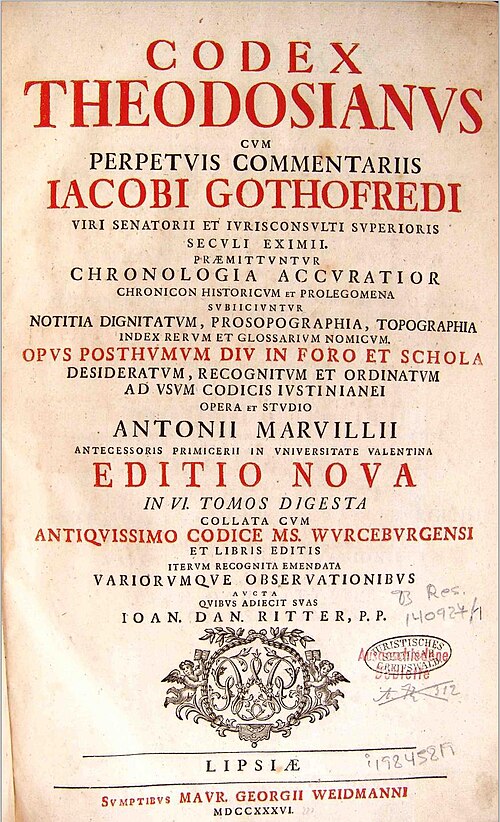
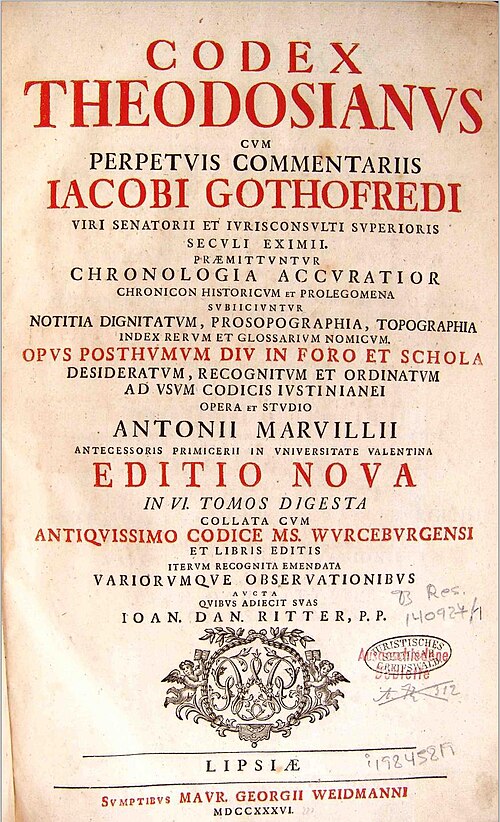
Codex Theodosianus XVI.1.2 (carrier)
compiled AD 438; 6th-c. manuscriptsThe edict survives as the opening law of the Theodosian Code's book on religion.
Provenance
Thessalonica, 27 February AD 380 — 'Cunctos populos': Nicene Christianity as law
Editions & scholarship
Critical editions and standard translations behind the text above.
- Theodosiani libri XVI cum constitutionibus SirmondianisTh. Mommsen & P. M. Meyer, 1905The critical edition of the Code.
- The Theodosian Code and NovelsClyde Pharr, 1952The standard English translation.