The Nicene Age · AD 313–400 · External witness
Emperor Theodosius I
d. 17 January 395 · Roman Emperor (379–395) · Establisher of Nicene Christianity · Hispania → Constantinople → Milan
External witness
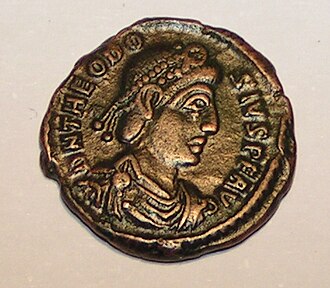
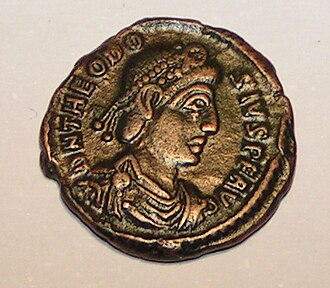

Who Emperor Theodosius I was
The Spanish soldier raised to the purple after Adrianople, whose Edict of Thessalonica (380) made the Nicene faith — “the religion which the divine apostle Peter delivered to the Romans” — the law of the empire, and whose council of Constantinople (381) completed the creed. He outlawed the heresies by statute, expelled the Arians from the capital’s churches, and ended the pagan sacrifices. Yet the church’s most vivid memory of him is his submission: after the massacre at Thessalonica, Ambrose barred him from communion until he did public penance — and the master of the world obeyed. Classed among the external witnesses as an imperial power per the typology (his own faith was ardently Nicene): the sword that established the creed, and the first sovereign to kneel to the church’s discipline.
Also listed in non-christian witnesses and roman emperors.
Common questions
When did Emperor Theodosius I die?
Emperor Theodosius I is dated d. 17 January 395 in the archive, which places Emperor Theodosius I in the Nicene Age (AD 313–400).
What did Emperor Theodosius I write?
Emperor Theodosius I has 1 catalogued writing in the archive: The Edict of Thessalonica (Cunctos populos).
Which early sources mention Emperor Theodosius I?
Emperor Theodosius I is named in 4 primary-source passages catalogued here, drawn from Theodosius, Gratian & Valentinian II, Ambrose of Milan, Augustine of Hippo and Theodoret of Cyrrhus. Every passage is quoted from a named public-domain translation, earliest first.
Where was Emperor Theodosius I from?
The archive associates Emperor Theodosius I with Hispania, Constantinople, Milan. The sources record more than one location, so the places are listed in the order the record moves through them.
Writings (1)
The Edict of Thessalonica (Cunctos populos)
27 February AD 380It is our will that all the peoples whom the rule of our clemency governs shall practise that religion which the divine apostle Peter delivered to the Romans.Read the interlinear source text →
Primary-source mentions (4)
Every passage below is quoted from a named public-domain translation, earliest first.
Edict of Thessalonica (Cod. Theod. XVI.1.2, via the church historians)
c. AD 381It is our will that all the peoples whom the government of our clemency rules shall follow that religion which the divine apostle Peter delivered to the Romans… that we shall believe in the one deity of the Father, the Son, and the Holy Spirit, in equal majesty and in a holy Trinity.Theodosius, Gratian & Valentinian II · source text
On the Death of Theodosius 34
c. AD 385He stripped himself of every emblem of royalty, and bewailed his sin openly in the church… with tears and groans he prayed for pardon. What private men blush to do, the emperor did not blush to do.Ambrose of Milan · source text
City of God V.26 (the felicity of Christian emperors)
c. AD 426He was more glad to be a member of this church than he was to be a king upon the earth.Augustine of Hippo · City of God V.26
Augustine's De Civitate Dei, the twenty-two books written between AD 413 and 426. Critical text: Bernhard Dombart and Alfons Kalb, Corpus Christianorum Series Latina 47–48 (1955). English translation by Marcus Dods, Nicene and Post-Nicene Fathers, 1st series, vol. 2 (1887), public domain.
Ecclesiastical History V.17–18 (Thessalonica, and the penance at Milan)
c. AD 449You have imitated David in his crime; imitate him also in his repentance.Theodoret of Cyrrhus · Ecclesiastical History V.17 · source text
Connected in the archive
People
- Ambrose of Milan
- Gregory of Nazianzus
- Nectarius of Constantinople
- Eunomius of Cyzicus
- Emperor Valens
- Maximus the Cynic
- Emperor Gratian
- Isaac of Dalmatia
- Ascholius (Acholius) of Thessalonica
- Aelia Flaccilla
- Demophilus of Constantinople
- Emperor Valentinian II
- Eugenius
- John of Lycopolis
- Flavius Butheric
Events in this lifetime
- AD 325 · The Council of Nicaea, AD 325
- AD 339 · The persecution of Shapur II, AD 339
- AD 343 · The Council of Serdica, AD 343
- AD 361 · Julian’s pagan restoration, AD 361
- AD 366 · Damasus and the catacomb epigrams, AD 366
- AD 367 · Athanasius lists the 27 NT books, AD 367
- AD 372 · The martyrdom of Sabbas the Goth, AD 372
- AD 378 · Queen Mavia’s revolt, AD 378
- AD 380 · The Edict of Thessalonica, AD 380
- AD 381 · The Council of Constantinople, AD 381
- AD 381 · The Council of Aquileia, AD 381
- AD 384 · The Altar of Victory petition, AD 384
- AD 390 · Thessalonica and the penance of Theodosius, AD 390
Place
Places served
The 3 places the sources put Emperor Theodosius I, in the order the record moves through them. This is what the sources attest, not a reconstructed route.
- 1Hispaniaprovince only
- 2Constantinople
- 3Milan