The Nicene Age · AD 313–400 · External witness
Emperor Gratian
AD 359 – 383 (murdered at Lyon) · Emperor of the West · Pupil of Ambrose · Trier → Milan → Lyon
External witness
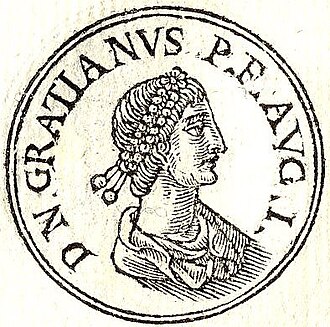
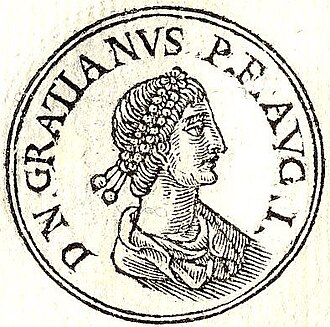

Who Emperor Gratian was
Valentinian's son, emperor at sixteen — the pupil for whom Ambrose wrote On the Faith, the colleague who raised Theodosius after Adrianople, and the first emperor to refuse the robe of pontifex maximus, strip the state subsidies from the old cults, and carry the Altar of Victory out of the Senate house. He recalled the bishops Valens had exiled and returned the churches to the Nicene communion; Magnus Maximus's revolt caught him at Lyon, where he was murdered at a parley. Typed external per the emperor rule.
Also listed in non-christian witnesses and roman emperors.
Common questions
When did Emperor Gratian live?
Emperor Gratian is dated AD 359 – 383 (murdered at Lyon) in the archive, which places Emperor Gratian in the Nicene Age (AD 313–400).
What did Emperor Gratian write?
Emperor Gratian has 1 catalogued writing in the archive: The Edict of Thessalonica (Cunctos populos), co-issued.
Which early sources mention Emperor Gratian?
Emperor Gratian is named in 3 primary-source passages catalogued here, drawn from Ambrose of Milan, Ammianus Marcellinus and Theodoret of Cyrus. Every passage is quoted from a named public-domain translation, earliest first.
Where was Emperor Gratian from?
The archive associates Emperor Gratian with Trier, Milan, Lyon. The sources record more than one location, so the places are listed in the order the record moves through them.
Writings (1)
The Edict of Thessalonica (Cunctos populos), co-issued
The three Augusti's law of 380 — Gratian's name stands first in the superscriptionIt is our will that all the peoples ruled by our clemency should practice that religion which the divine apostle Peter delivered to the Romans.Read the interlinear source text →
Primary-source mentions (3)
Every passage below is quoted from a named public-domain translation, earliest first.
Letters of Ambrose to Gratian (with De Fide, written at the emperor's request)
c. AD 379Res Gestae XXXI.10 (the young Augustus in the field)
c. AD 390Ecclesiastical History of Theodoret V.2
c. AD 449Gratian commanded that the bishops banished by Valens be recalled, and that the sacred buildings be delivered to those who held the communion of Damasus.Theodoret of Cyrus · V.2 · source text
Connected in the archive
People
Events in this lifetime
- AD 313 · The Edict of Milan, AD 313
- AD 314 · The Council of Arles, AD 314
- AD 320 · Silvanus tried before Zenophilus, AD 320
- AD 325 · The Council of Nicaea, AD 325
- AD 339 · The persecution of Shapur II, AD 339
- AD 343 · The Council of Serdica, AD 343
- AD 361 · Julian’s pagan restoration, AD 361
- AD 366 · Damasus and the catacomb epigrams, AD 366
- AD 367 · Athanasius lists the 27 NT books, AD 367
- AD 372 · The martyrdom of Sabbas the Goth, AD 372
- AD 378 · Queen Mavia’s revolt, AD 378
- AD 380 · The Edict of Thessalonica, AD 380
- AD 381 · The Council of Constantinople, AD 381
- AD 381 · The Council of Aquileia, AD 381
Place
Places served
The 3 places the sources put Emperor Gratian, in the order the record moves through them. This is what the sources attest, not a reconstructed route.