Event · AD 367 · Alexandria
Athanasius lists the 27 NT books, AD 367
Athanasius lists the 27 NT books
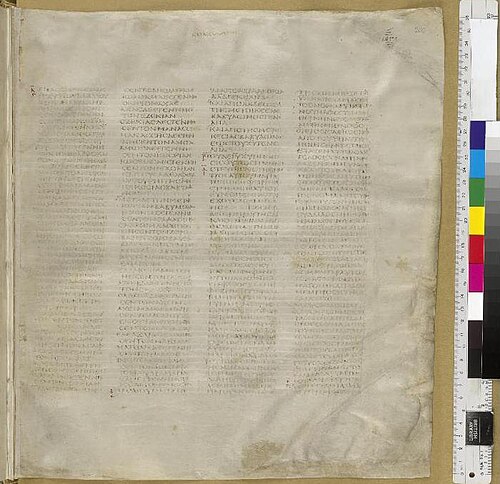
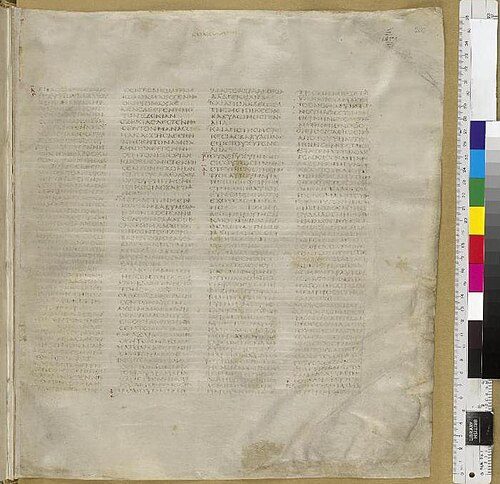

**An Easter letter that settled a question no council had settled — and the archive holds the letter, and two of the books it excludes.**
Every year the bishop of Alexandria wrote to the Egyptian and Libyan churches to announce the date of Easter. **In 367 Athanasius used the letter to enumerate scripture**, and the list of the New Testament he gives is exactly the twenty-seven books the church has held ever since: the four Gospels, Acts, the seven catholic epistles, the fourteen of Paul including Hebrews, and the Revelation of John. **It is the first surviving list that matches.**
## The sentence that did the work
**“These are fountains of salvation, that they who thirst may be satisfied with the living words they contain. In these alone is proclaimed the doctrine of godliness. Let no man add to these, neither let him take ought from these.”** No council is invoked; no emperor. A bishop states a canon and closes it.
## The Old Testament list is not the one a modern reader expects
**Twenty-two books, on the Hebrew reckoning** — “for, as I have heard, it is handed down that this is the number of the letters among the Hebrews” — with Kings, Chronicles and Ezra each counted as one book, the twelve prophets as one, and **Jeremiah counted together with Baruch, Lamentations and the epistle.**
**And Esther is not in it.** Athanasius puts Esther in a second class, with the Wisdom of Solomon, Sirach, Judith, Tobit, **“that which is called the Teaching of the Apostles, and the Shepherd”** — books “not indeed included in the Canon, but appointed by the Fathers to be read by those who newly join us”. **Baruch inside, Esther outside**: the archive states that plainly, because it is the clearest evidence that a fourth-century canon list is not a modern table of contents.
## Two of the excluded books are on these shelves
**The *Teaching of the Apostles* is the Didache and the *Shepherd* is Hermas**, and this library holds both. So the record can do something unusual: link the canon list to the very texts it demotes, and let a reader see what a book “appointed to be read” actually looked like. **The Muratorian fragment, also held, had already excluded the Shepherd two centuries earlier** — on the different ground that it was written too recently, “while his brother Pius sat in the chair of the church of Rome.”
## ⚠ Three cautions
**The text is a reconstruction.** The Greek survives in fragments; the fullest witness is Coptic, with Syriac supplementing. What is quoted above is secure, but the letter as a whole is assembled from pieces.
**And its own editors flag a problem with one piece.** The NPNF editor notes that the opening section is preserved in the Coptic *Life of Theodore* — the Pachomian abbot the archive holds as a figure — and that **if Theodore died in 364 he cannot have received a letter of 367**, so that section may be his biographer’s composition rather than Athanasius’s. **The archive records the editor’s doubt rather than the tidy attribution.**
**It was one bishop’s letter, not legislation.** Its enumeration became binding for the Latin West thirty years later, at the Council of Carthage of 397 — which this archive holds as its own event. **Athanasius set the list; a council made it law**, and Jerome’s prefaces argue the same twenty-two-book Hebrew reckoning from the other end of the Mediterranean.
The sources for this event
Every source the record rests on, with what it says and what it cannot carry.
Athanasius, Festal Letter 39
c. AD 367“There are, then, of the Old Testament, twenty-two books in number; for, as I have heard, it is handed down that this is the number of the letters among the Hebrews… then Jeremiah with Baruch, Lamentations, and the epistle, one book.” … “These are fountains of salvation, that they who thirst may be satisfied with the living words they contain. In these alone is proclaimed the doctrine of godliness. **Let no man add to these, neither let him take ought from these.**” … “But for greater exactness I add this also, writing of necessity; that there are other books besides these not indeed included in the Canon, but appointed by the Fathers to be read by those who newly join us… **The Wisdom of Solomon, and the Wisdom of Sirach, and Esther, and Judith, and Tobit, and that which is called the Teaching of the Apostles, and the Shepherd.**” [⚠ **Esther is in the second class and Baruch in the first** — the archive states it because it is the plainest proof that this list is not a modern table of contents.]
*Festal Letter 39* — held in this library. English: NPNF 2nd ser. 4 (1892), public domain. ⚠ The Greek survives only in fragments; the fullest text is Coptic, with Syriac witnesses. The NPNF editor flags a chronological problem with the section preserved in the Coptic *Life of Theodore*.
Read the source text →The Didache — Athanasius’s “Teaching of the Apostles”
c. AD 100[Linked because Athanasius names it: **the archive holds one of the two books his second class identifies.** A reader can go from the canon list to the text it demotes and see what “appointed by the Fathers to be read” meant in practice — a church order with a catechism, a baptismal rubric and a eucharistic prayer. ⚠ Whether Athanasius means this text by *Teaching of the Apostles* is the standard identification, not a certainty; the archive states it as the received view.]
*The Didache* — held in this library. English: public-domain translations of the 1883 Bryennios text. Named by Athanasius among the books to be read but not canonical.
Read the source text →The Shepherd of Hermas — Athanasius’s “Shepherd”
c. AD 150[The other excluded book the archive holds — and one that had been read as scripture: **it stands inside the fourth-century Codex Sinaiticus**, which is why a bishop in 367 had to say where it belonged. Athanasius keeps it for catechumens and out of the canon.]
*The Shepherd* — held in this library. English: ANF 2, public domain. Named by Athanasius among the books to be read but not canonical.
Read the source text →The Muratorian Fragment
c. AD 180[The comparison that shows what Athanasius achieved. The oldest surviving list is **mutilated at the head**, and it excludes the Shepherd for a different reason — “for Hermas wrote it quite lately, in our times, while his brother Pius sat in the chair of the church of Rome.” **Two centuries apart, both lists exclude the same book on incompatible grounds**: too recent in Rome, edifying but uncanonical in Alexandria. ⚠ The fragment’s own date is disputed, and the archive keeps the dispute on its text record.]
*The Muratorian Fragment* — held in this library; the list is dated c. AD 170–200, though a fourth-century date has been argued. English: public domain.
Read the source text →Figures in this event (5)
- Athanasius of Alexandria
- The Didachist (Author of the Didache)
- Hermas of Rome
- Theodore of Tabennese
- Jerome of Stridon
Scholarship
- The Canon of the New Testament: Its Origin, Development, and SignificanceBruce M. Metzger, 1987The standard account of how the list was arrived at, and of what Letter 39 did and did not settle.
- Canon Formation and Social Conflict in Fourth-Century EgyptDavid Brakke, 1994Harvard Theological Review 87. Reads the letter as an act of episcopal discipline against Egyptian ascetic reading practice.
- The Biblical Canon: Its Origin, Transmission, and AuthorityLee Martin McDonald, 2007Third edition; sets Athanasius’s list beside the codices and the later councils.