Primary source · Latin (from a Greek original)
The Muratorian Fragment
Anonymous (Rome) · canon-list c. AD 170–200

What this text is
The oldest surviving list of New Testament books — mutilated at its head, naming the Shepherd as too recent for the canon 'for Hermas wrote it quite lately, in our times, while his brother Pius sat in the chair of the church of Rome.'
Interlinear passages
Word-for-word glosses of the original; the complete public-domain translation is linked below.
Public-domain translations
B. F. Westcott (1870)
…at which nevertheless he was present, and so he set them down. The third book of the Gospel, that according to Luke… The Pastor, moreover, Hermas wrote very recently in our times in the city of Rome, while his brother Pius, the bishop, occupied the chair of the church of the city of Rome.
Manuscript witnesses
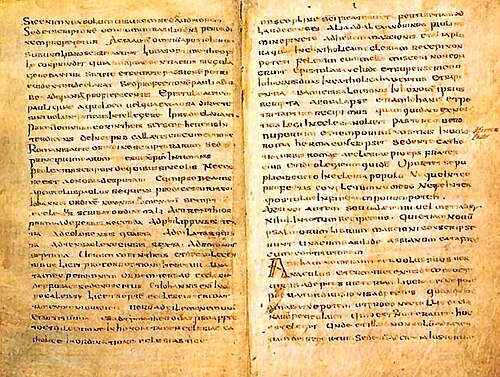
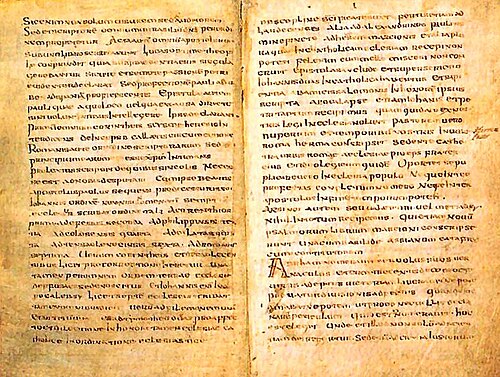
Milan, Biblioteca Ambrosiana, Cod. J 101 sup., ff. 10r–11r
7th–8th c.Eighty-five lines of rough Latin in a Bobbio miscellany — the oldest list of New Testament books, missing its beginning.
Monte Cassino Pauline codices (excerpts)
11th–12th c.A few sentences recur in Cassinese manuscripts of Paul — proof the text once circulated more widely.
Muratori, Antiquitates Italicae III
1740The discovery publication that gave the canon its name.
Provenance
Rome or its orbit, c. AD 170–200 (Latin copy, 7th–8th c.); found at Bobbio's library
Editions & scholarship
Critical editions and standard translations behind the text above.
- The Canon of the New Testament: Its Origin, Development, and SignificanceBruce M. Metzger, 1987The standard treatment, with full translation of the fragment.
- The Muratorian Fragment and the Development of the CanonGeoffrey Mark Hahneman (with the replies of C. E. Hill et al.), 1992–The modern dating debate, both sides.