The Nicene Age · AD 313–400 · External witness
Emperor Valens
d. 9 August AD 378 · Roman Emperor of the East (364–378) · Arian persecutor · Constantinople → Adrianople
External witness
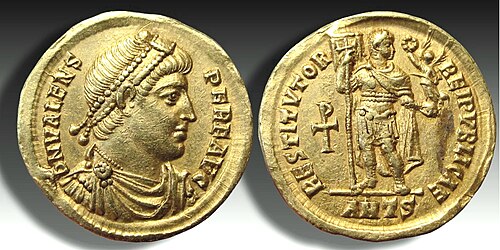
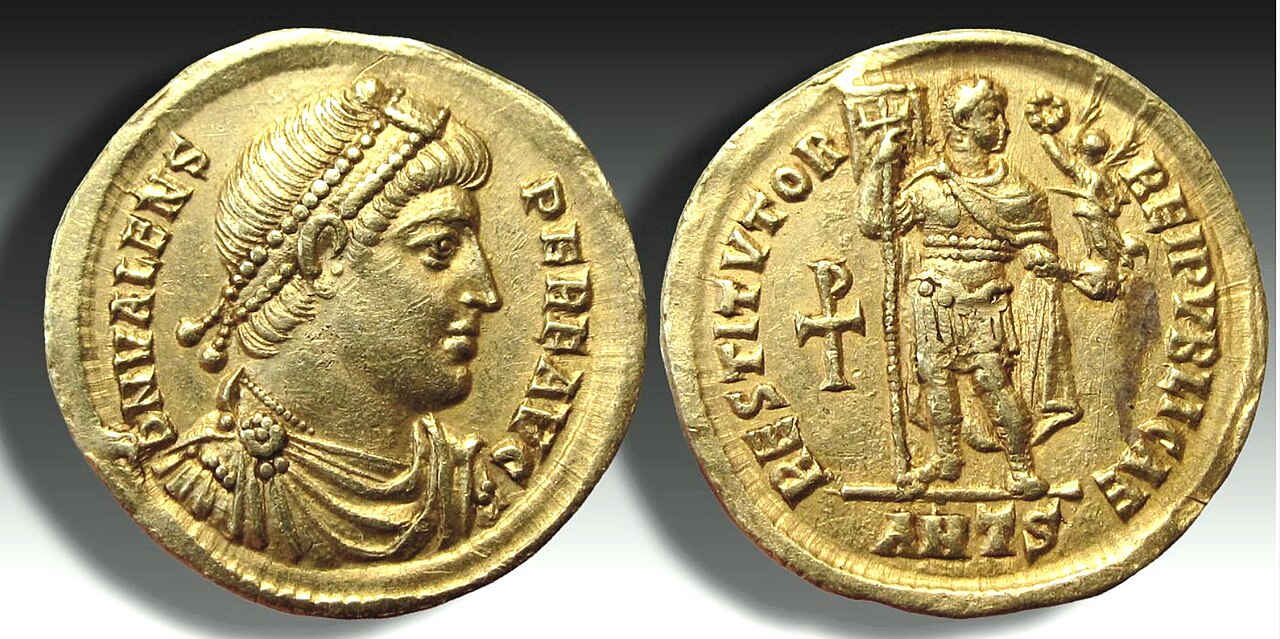

Who Emperor Valens was
Emperor of the East and a convinced Arian (baptized by the Arian bishop of Constantinople), who through his reign harried the Nicene churches — exiling their bishops, persecuting the Egyptian monks, and confronting Basil of Caesarea, whose immovable dignity, the story goes, so awed the emperor that he left him his see. His pressure made Basil and the Cappadocians the heroes of the Nicene resistance in the East. Valens died catastrophically at Adrianople in 378, his army destroyed and his body never found, in the battle that let the Goths into the empire — a disaster the Nicene writers did not fail to read as judgment on an Arian reign. His death cleared the way for Theodosius and the triumph of Nicaea in 381.
Also listed in non-christian witnesses, heretics & schismatics and roman emperors.
Common questions
When did Emperor Valens die?
Emperor Valens is dated d. 9 August AD 378 in the archive, which places Emperor Valens in the Nicene Age (AD 313–400).
Which early sources mention Emperor Valens?
Emperor Valens is named in 3 primary-source passages catalogued here, drawn from Ammianus Marcellinus, Socrates Scholasticus and Theodoret of Cyrrhus. Every passage is quoted from a named public-domain translation, earliest first.
Where was Emperor Valens from?
The archive associates Emperor Valens with Constantinople, Adrianople. The sources record more than one location, so the places are listed in the order the record moves through them.
Who were Emperor Valens’ contemporaries?
The archive links Emperor Valens to 10 other figures, including Basil the Great, Athanasius of Alexandria, Macedonius of Constantinople and Eudoxius of Antioch and Constantinople. Each connection is drawn from a source that places them together, not from inference.
Primary-source mentions (3)
Every passage below is quoted from a named public-domain translation, earliest first.
Res Gestae XXXI.13 (Adrianople and the burning farmhouse)
c. AD 390Never, except in the battle of Cannae, had there been so destructive a slaughter recorded in our annals.Ammianus Marcellinus · Res Gestae XXXI.13 · source text
Ecclesiastical History IV.16, 26 (Socrates)
c. AD 439Valens… dealt hardly with those who would not embrace the Arian opinion, driving the bishops into exile and harassing the churches; but coming against Basil, he found a man whom threats could not move.Socrates Scholasticus · 26 · source text
Ecclesiastical History IV.19 (the confrontation with Basil at the Epiphany liturgy)
c. AD 449Connected in the archive
People
- Basil the Great
- Athanasius of Alexandria
- Macedonius of Constantinople
- Eudoxius of Antioch and Constantinople
- Emperor Valentinian I
- Lucius of Alexandria
- Peter II of Alexandria
- Isaac of Dalmatia
- Ulfilas (Wulfila)
- Emperor Theodosius I
Named alongside Emperor Valens in the sources
This figure is placed with Emperor Valens by the record — in a council roll, a martyr-act, a letter or a history — without Emperor Valens naming them in return.
Events in this lifetime
- AD 311 · Galerius’ edict of Serdica, AD 311
- AD 313 · The Edict of Milan, AD 313
- AD 314 · The Council of Arles, AD 314
- AD 320 · Silvanus tried before Zenophilus, AD 320
- AD 325 · The Council of Nicaea, AD 325
- AD 339 · The persecution of Shapur II, AD 339
- AD 343 · The Council of Serdica, AD 343
- AD 361 · Julian’s pagan restoration, AD 361
- AD 366 · Damasus and the catacomb epigrams, AD 366
- AD 367 · Athanasius lists the 27 NT books, AD 367
- AD 372 · The martyrdom of Sabbas the Goth, AD 372
- AD 378 · Queen Mavia’s revolt, AD 378
Place
Places served
The one place the sources put Emperor Valens.