Event · AD 390 · Thessalonica — the circus · Milan
Thessalonica and the penance of Theodosius, AD 390
The Thessalonica massacre and the penance of Theodosius — Butheric lynched, seven thousand killed in reprisal
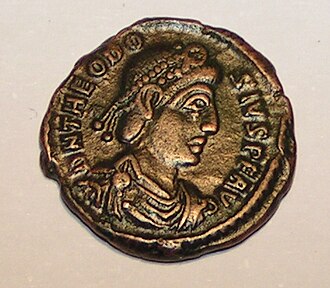
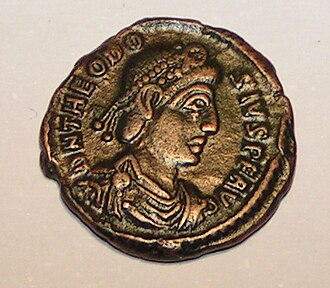

**The most consequential act of church discipline in the archive's period, and the record is careful about how little the contemporary sources actually say.**
In the spring of 390 **Flavius Butheric**, commanding in Illyricum, was lynched by a crowd at Thessalonica in a dispute over the detention of a popular charioteer. **The imperial reprisal fell on the city's circus**, and the number usually given is **seven thousand**. **Ambrose** refused Theodosius communion until he did public penance; the emperor did, and was readmitted **at Christmas 390, after some eight months.**
## What each source contributes, and when
**Ambrose wrote at once — and does not describe the massacre.** His letter to the emperor deplores the act and sets the terms of penance without narrating what happened. **The one contemporary document is a pastoral ultimatum, not a report.**
**Every narrative account is fifth-century.** Rufinus, Socrates, Sozomen and Theodoret all wrote a generation or more later. **The seven thousand is Theodoret's figure**, echoed by Sozomen. **Sozomen is the only source for the charioteer** at all.
**So the archive prints the sequence and marks the joins.** That the people rose and killed at least one official is agreed. That an imperial punishment followed which ended in a massacre is agreed. **Whether the scale of the killing was ordered or exceeded its orders is not established** — the phrase modern scholarship uses is *intentionally or not* — and the number rests on one fifth-century historian.
## Why the penance mattered more than the massacre
**A Roman emperor was excluded from the sacraments by a bishop, submitted, and said so publicly.** Ambrose's letter offers the emperor a way to do it — and the archive notes the reading that this was a route to restore a damaged reputation as much as a punishment. **Both readings fit the same document**, and the record gives both.
**It became the founding precedent for the church's claim to judge a Christian ruler**, cited for a thousand years afterwards, and it is the reason a bishop of Milan is remembered beside an emperor. **The archive holds the funeral oration Ambrose preached for that same emperor five years later** — “I have loved a man who esteemed a reprover more than a flatterer” — which is the two men's own account of what had passed between them.
## ⚠ Three cautions
**No contemporaneous narrative exists**, and no administrative record. **The archive's evidence for the largest atrocity in its period is a bishop's letter that does not describe it, and four historians writing after the participants were dead.**
**The confrontation's staging is disputed.** Theodoret and Sozomen place the meeting with Ambrose at Milan after the emperor's return, and the dramatic scene at the church door is theirs, not Ambrose's.
**And a law is contested.** A constitution requiring a delay before capital sentences is often attached to this episode; **Errington argued it was issued in 382 and unrelated**, and most scholars who date it to 390 are divided about whether it followed the massacre. The archive states the disagreement instead of using the law as evidence.
The sources for this event
Every source the record rests on, with what it says and what it cannot carry.
Ambrose of Milan, Letter 51 — to Theodosius after Thessalonica
c. AD 390[The bishop writes privately to the emperor, refuses to celebrate in his presence, and sets out what repentance would require — **without narrating the massacre at all.** The archive draws the consequence plainly: **the one contemporary source for the best-known atrocity of the fourth century supplies no account of it**, and everything the story consists of comes from writers of the next century.]
*The Letters of Ambrose* — held in this library. English: H. de Romestin, NPNF 2nd ser. 10 (1896), public domain. ⚠ **Written immediately after the event and the only contemporary document** — and it deplores the act without describing it. Whether Ambrose yet had details is unknown.
Read the source text →Theodoret, Ecclesiastical History V.17–18
c. AD 449“The anger of the Emperor rose to the highest pitch, and he gratified his vindictive desire for vengeance by unsheathing the sword most unjustly and tyrannically against all, slaying the innocent and guilty alike… **It is said seven thousand perished without any forms of law, and without even having judicial sentence passed upon them**; but that, like ears of wheat in the time of harvest, they were alike cut down.” [⚠ Theodoret also supplies the scene at the church door that every later retelling depends on. **The archive marks the number and the scene as his**, sixty years after, and notes his own hedge: *it is said.*]
Theodoret, *Ecclesiastical History* — held in this library. English: B. Jackson, NPNF 2nd ser. 3 (1892), public domain. ⚠ Written c. 449, some sixty years after the events, and **the source of the seven thousand.**
Read the source text →Sozomen, Ecclesiastical History VII.25
c. AD 443[Sozomen gives the fullest narrative and the causal detail no one else has — **the popular charioteer, his arrest by Butheric, the crowd's demand for his release, and the lynching that followed.** Modern assessment treats his account as the most informative of the four. ⚠ It is also the account furthest from a document: **a fifth-century historian supplying the motive of a fourth-century riot.**]
Sozomen, *Ecclesiastical History* — held in this library. English: C. D. Hartranft, NPNF 2nd ser. 2 (1890), public domain. ⚠ Written c. 443; **the only source for the charioteer** whose arrest set the riot off.
Read the source text →Ambrose of Milan, On the Death of Theodosius
c. AD 395“**I have loved a man who esteemed a reprover more than a flatterer.**” [The two men's own settlement of the affair, spoken five years later over the emperor's coffin. **The archive keeps it beside the letter of 390 deliberately**: the same bishop, the same emperor, the rebuke and the eulogy — and the eulogy is the reason the penance was remembered as a reconciliation rather than a humiliation.]
*On the Death of Theodosius* — held in this library. English: H. de Romestin, NPNF 2nd ser. 10 (1896), public domain. ⚠ A funeral oration delivered over the body, by the man who had excluded him from communion five years earlier.
Read the source text →Figures in this event (4)
Scholarship
- Rethinking a massacre: What really happened in Thessalonica and Milan in 390?Stanislav Doležal, 2014Sets the sources in order of composition and shows how little the contemporary evidence supports.
- Ambrose of Milan: Church and Court in a Christian CapitalNeil B. McLynn, 1994Reads Ambrose's letter as offering the emperor a way to recover his position, not only as a rebuke.
- Theodosius: The Empire at BayStephen Williams and Gerard Friell, 1994The reign, the massacre and the penance in their political sequence.