The Nicene Age · AD 313–400 · External witness
Emperor Constantius II
d. 3 November 361 · Roman Emperor (337–361) · Arianizing sovereign · Constantinople → Cilicia
External witness
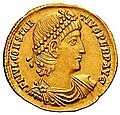
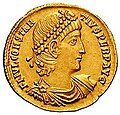

Who Emperor Constantius II was
Constantine’s son and the Nicene cause’s most powerful adversary — not a pagan persecutor but a Christian emperor determined to impose the compromise creeds of his court theologians on the whole church: under his pressure Athanasius fled into his third exile, Liberius of Rome and the centenarian Hosius were broken into compromising signatures, and the councils of Ariminum and Seleucia (359) made — in Jerome’s famous groan — “the whole world groan and marvel to find itself Arian.” Athanasius, who had once flattered him, finally named him “patron of impiety and emperor of heresy… more cruel than Pilate.” He died marching against his cousin Julian, baptized on his deathbed by an Arian bishop. The archetype of doctrine enforced by throne.
Also listed in non-christian witnesses, heretics & schismatics and roman emperors.
Common questions
When did Emperor Constantius II die?
Emperor Constantius II is dated d. 3 November 361 in the archive, which places Emperor Constantius II in the Nicene Age (AD 313–400).
What did Emperor Constantius II write?
Emperor Constantius II has 1 catalogued writing in the archive: Imperial letters.
Which early sources mention Emperor Constantius II?
Emperor Constantius II is named in 4 primary-source passages catalogued here, drawn from Athanasius of Alexandria, Hilary of Poitiers and Ammianus Marcellinus. Every passage is quoted from a named public-domain translation, earliest first.
Where was Emperor Constantius II from?
The archive associates Emperor Constantius II with Constantinople, Cilicia. The sources record more than one location, so the places are listed in the order the record moves through them.
Writings (1)
Imperial letters
His own hand survives embedded in his opponents' dossiers — the demand that Axum surrender Frumentius, among othersIt is altogether a matter of the greatest care to us, that the state of the Church be preserved. (the letter to Aizanas and Sazanas, via Athanasius)Read the interlinear source text →
Primary-source mentions (4)
Every passage below is quoted from a named public-domain translation, earliest first.
History of the Arians 45–46, 67
c. AD 350Let Constantius be called the patron of impiety and emperor of heresy… he has surpassed those before him in wickedness, devising a new mode of persecution.Athanasius of Alexandria · 67 · source text
Apology to Constantius (Athanasius pleads to the sovereign's face)
c. AD 357Knowing that you have been a Christian for many years, most religious Augustus, and are godly by descent, I cheerfully undertake to answer for myself.Athanasius of Alexandria · Apology to Constantius 1 · source text
Hilary, Against Constantius (the Gallic bishop's open declaration of war)
c. AD 360[Hilary, writing after the emperor is dead, names Constantius Antichrist, and a tyrant whose one aim was to make the devil a gift of the world for which Christ suffered.]Hilary of Poitiers · Against Constantius
Hilary's Liber contra Constantium Imperatorem, written c. AD 361 after the emperor's death and circulated as an invective — the sharpest attack on a reigning house by any fourth-century Western bishop. Critical text with French translation: André Rocher, Sources Chrétiennes 334 (1987). English translation by Richard Flower, Imperial Invectives against Constantius II, Translated Texts for Historians (Liverpool, 2016). The work is not in the Nicene and Post-Nicene Fathers and no public-domain English exists.
Res Gestae XXI.16 (the obituary: 'the plain and simple religion of the Christians he confounded with old wives' superstition')
c. AD 390The Christian religion, absolute and simple, he confounded with old wives' superstition.Ammianus Marcellinus · Res Gestae XXI.16 · source text
Connected in the archive
People
- Hosius of Cordova
- Liberius of Rome
- Eusebius of Vercelli
- Athanasius of Alexandria
- Emperor Julian the Apostate
- Ezana (Aizanas) of Axum
- Gregory of Cappadocia
- Paul of Constantinople
- Magnentius
- Gallus Caesar
- Paulinus of Trier
- George of Cappadocia
- Basil of Ancyra
- Acacius of Caesarea
- Ursacius of Singidunum
- Valens of Mursa
Events in this lifetime
- AD 301 · Hripsime and her company, AD 301
- AD 303 · The Great Persecution begins, AD 303
- AD 303 · The search of the church at Cirta, AD 303
- AD 306 · The Council of Elvira, AD 306
- AD 311 · Galerius’ edict of Serdica, AD 311
- AD 313 · The Edict of Milan, AD 313
- AD 314 · The Council of Arles, AD 314
- AD 320 · Silvanus tried before Zenophilus, AD 320
- AD 325 · The Council of Nicaea, AD 325
- AD 339 · The persecution of Shapur II, AD 339
- AD 343 · The Council of Serdica, AD 343
- AD 361 · Julian’s pagan restoration, AD 361
Place
Places served
The 2 places the sources put Emperor Constantius II, in the order the record moves through them. This is what the sources attest, not a reconstructed route.
- 1Constantinople
- 2Ciliciaprovince only