The Nicene Age · AD 313–400 · External witness
Emperor Julian the Apostate
d. 26 June AD 363 · Roman Emperor (361–363) · Restorer of paganism · Constantinople → Antioch → Persia
External witness
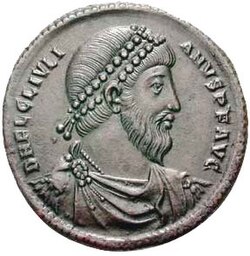
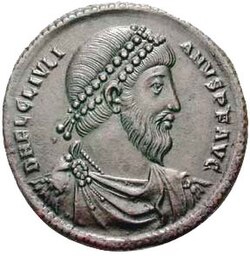
-CNG.jpg)
Who Emperor Julian the Apostate was
Nephew of Constantine, raised a Christian and made a lifelong secret pagan by the murder of his family and the philosophy of the Neoplatonic schools, Julian on becoming sole emperor in 361 threw off the mask and tried to reverse the Christian revolution — restoring the temples, rebuilding a pagan priesthood on the church’s own model of charity, and, most cuttingly, barring Christians from teaching the classics (“let them content themselves with expounding Matthew and Luke”). He mocked the “Galileans” in learned treatises and began rebuilding the Jerusalem temple to falsify Christ’s prophecy, until (the Christians exulted) fireballs stopped the work. Killed in his second year fighting the Persians — “Thou hast conquered, O Galilean,” the legend put in his mouth — he left paganism’s last serious bid spent. Gregory of Nazianzus’s invectives against him are the church’s answer to its most intellectually formidable imperial enemy.
Also listed in non-christian witnesses and roman emperors.
Common questions
When did Emperor Julian die?
Emperor Julian the Apostate is dated d. 26 June AD 363 in the archive, which places Emperor Julian in the Nicene Age (AD 313–400).
What did Emperor Julian write?
Emperor Julian the Apostate has 2 catalogued writings in the archive: Against the Galileans and Rescript on Christian teachers (Ep. 36).
Which early sources mention Emperor Julian?
Emperor Julian the Apostate is named in 4 primary-source passages catalogued here, drawn from Ephrem the Syrian, Gregory of Nazianzus, Ammianus Marcellinus and Theodoret of Cyrrhus. Every passage is quoted from a named public-domain translation, earliest first.
Where was Emperor Julian from?
The archive associates Emperor Julian the Apostate with Constantinople, Antioch, Persia. The sources record more than one location, so the places are listed in the order the record moves through them.
Writings (2)
Against the Galileans
AD 362–363It is, I think, expedient to set forth to all mankind the reasons by which I was convinced that the fabrication of the Galilaeans is a fiction of men composed by wickedness.Read the interlinear source text →
Rescript on Christian teachers (Ep. 36)
AD 362If they want to learn literature, they have Luke and Mark: let them go back to their churches and expound on them.Read the interlinear source text →
Primary-source mentions (4)
Every passage below is quoted from a named public-domain translation, earliest first.
Hymns against Julian (Ephrem's Syriac verdict, written beside the emperor's bier at Nisibis)
c. AD 363Oration 4, Against Julian
c. AD 380Hear this, all ye nations… A man rose up against Christ, who had drunk in impiety with his learning, and thought to overthrow the cross by cleverness; but he warred against One stronger than himself, and fell.Gregory of Nazianzus · source text
Res Gestae XXV.3–4 (the pagan admirer's deathbed portrait)
c. AD 390I do not lament my fate, like most men, having learnt from philosophy how much more excellent the soul is than the body.Ammianus Marcellinus · Res Gestae XXV.3 · source text
Ecclesiastical History III.25 ('Thou hast conquered, O Galilean' — the legend recorded)
c. AD 449He filled his hand with blood and flung it into the air, crying, 'Thou hast won, O Galilean.'Theodoret of Cyrrhus · Ecclesiastical History III.25 · source text
Connected in the archive
People
- Constantine the Great
- Caesarius of Nazianzus
- Marius Victorinus
- Gregory of Nazianzus
- Gallus Caesar
- Emperor Constantius II
- George of Cappadocia
- Artemius of Antioch
- Eupsychius of Caesarea
- Juventinus the Guardsman
- Mark of Arethusa
- Maximinus the Guardsman
- Emperor Jovian
- Maximus of Ephesus
- Titus of Bostra
- Themistius
- Libanius of Antioch
- Ammianus Marcellinus
- Philostorgius
Events in this lifetime
- AD 301 · Hripsime and her company, AD 301
- AD 303 · The Great Persecution begins, AD 303
- AD 303 · The search of the church at Cirta, AD 303
- AD 306 · The Council of Elvira, AD 306
- AD 311 · Galerius’ edict of Serdica, AD 311
- AD 313 · The Edict of Milan, AD 313
- AD 314 · The Council of Arles, AD 314
- AD 320 · Silvanus tried before Zenophilus, AD 320
- AD 325 · The Council of Nicaea, AD 325
- AD 339 · The persecution of Shapur II, AD 339
- AD 343 · The Council of Serdica, AD 343
- AD 361 · Julian’s pagan restoration, AD 361
Place
Places served
The 3 places the sources put Emperor Julian, in the order the record moves through them. This is what the sources attest, not a reconstructed route.
- 1Constantinople
- 2Antioch
- 3Sasanian Persiaprovince only