The Nicene Age · AD 313–400 · External witness
Emperor Licinius
d. AD 325 · Roman Emperor of the East (308–324) · the Balkans → the East
External witness
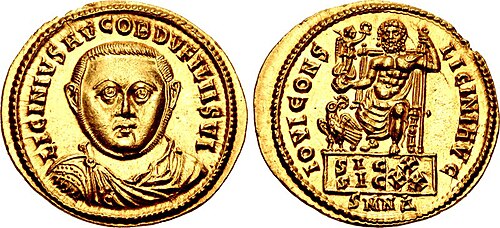
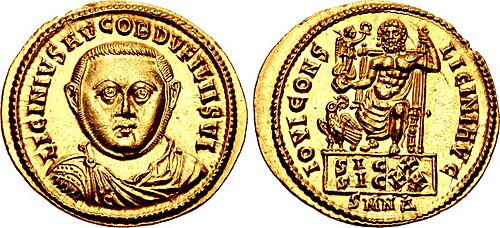

Who Emperor Licinius was
Constantine’s colleague and brother-in-law, with whom he issued the agreement at Milan in 313 that granted Christians and all others full freedom of worship and restored their confiscated property — the charter of the church’s legal freedom. But the alliance soured; in his later years Licinius turned against the Christians of his eastern domains, purging them from his court and army and harrying bishops, until Constantine defeated him in 324 and had him executed. He is thus double-faced in the record: co-author of the Edict of Milan, and the last persecutor whose fall left Constantine sole master of a Christian empire.
Also listed in non-christian witnesses and roman emperors.
Common questions
When did Emperor Licinius die?
Emperor Licinius is dated d. AD 325 in the archive, which places Emperor Licinius in the Nicene Age (AD 313–400).
What did Emperor Licinius write?
Emperor Licinius has 1 catalogued writing in the archive: The Edict of Milan (with Constantine).
Which early sources mention Emperor Licinius?
Emperor Licinius is named in 3 primary-source passages catalogued here, drawn from Lactantius and Eusebius of Caesarea. Every passage is quoted from a named public-domain translation, earliest first.
Where was Emperor Licinius from?
The archive associates Emperor Licinius with the Balkans, the East. The sources record more than one location, so the places are listed in the order the record moves through them.
Writings (1)
The Edict of Milan (with Constantine)
AD 313We resolved to grant both to the Christians and to all men freedom to follow the religion which each preferred.Read the interlinear source text →
Primary-source mentions (3)
Every passage below is quoted from a named public-domain translation, earliest first.
On the Deaths of the Persecutors 46–47 (the dictated prayer before Campus Ergenus)
c. AD 315Supreme God, we beseech Thee; Holy God, we beseech Thee... we stretch forth our arms to Thee.Lactantius · On the Deaths 46 · source text
Ecclesiastical History X.5 (the Edict of Milan)
c. AD 325We resolved… to grant both to the Christians and to all men freedom to follow the religion which they choose… that whatsoever divinity dwells in heaven may be favourable to us and to all under our authority.Eusebius of Caesarea · X.5 · source text
Life of Constantine I.49–II.18 (the last persecutor of the East)
c. AD 339Connected in the archive
People
- Constantine the Great
- Emperor Maximinus Daza
- Emperor Maxentius
- Theodore of Amasea (Tiro)
- Gordius of Caesarea
- The Forty Martyrs of Sebaste
Events in this lifetime
- AD 257 · The Valerian persecution, AD 257
- AD 260 · Gallienus’ edict of toleration, AD 260
- AD 268 · Antioch deposes Paul of Samosata, AD 268
- AD 272 · Aurelian awards the Antioch church, AD 272
- AD 301 · Hripsime and her company, AD 301
- AD 303 · The Great Persecution begins, AD 303
- AD 303 · The search of the church at Cirta, AD 303
- AD 306 · The Council of Elvira, AD 306
- AD 311 · Galerius’ edict of Serdica, AD 311
- AD 313 · The Edict of Milan, AD 313
- AD 314 · The Council of Arles, AD 314
- AD 320 · Silvanus tried before Zenophilus, AD 320
- AD 325 · The Council of Nicaea, AD 325
Place
Places served
The 2 places the sources put Emperor Licinius, in the order the record moves through them. This is what the sources attest, not a reconstructed route.
- 1the Balkansprovince only
- 2the Eastprovince only