Primary source · Latin
The Chronography of 354 (Depositio Martyrum & Episcoporum)
Furius Dionysius Filocalus (calligrapher) · compiled AD 336–354

What this text is
The illustrated Roman almanac whose church lists — the burial calendars of the martyrs and bishops of Rome — are the earliest surviving record of the Roman church's liturgical year, naming Sebastian, Fabian, Pope Mark and their tombs.
Profile of Furius Dionysius Filocalus →
Public-domain translations
Working translation (from the Latin)
The 13th day before the Kalends of February: Fabian in the cemetery of Callistus, and Sebastian in the Catacombs. (Depositio Martyrum) · The Nones of October: Mark, in the cemetery of Balbina. (Depositio Episcoporum)
Manuscript witnesses
Codex Luxemburgensis (lost)
Carolingian, lost after 1620The ninth-century copy of the fourth-century original, itself lost after Peiresc's circle copied it.
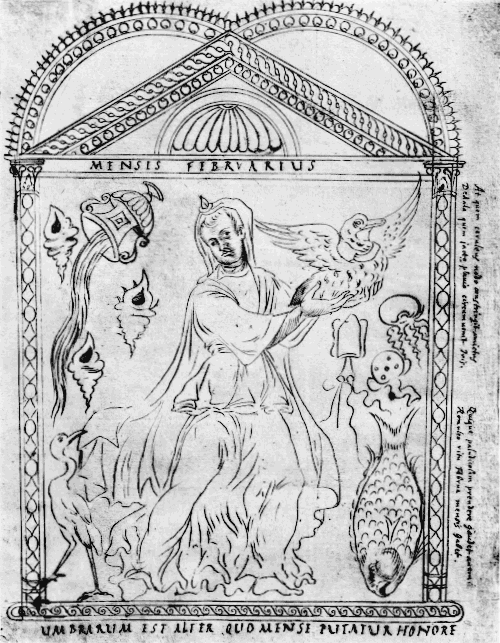
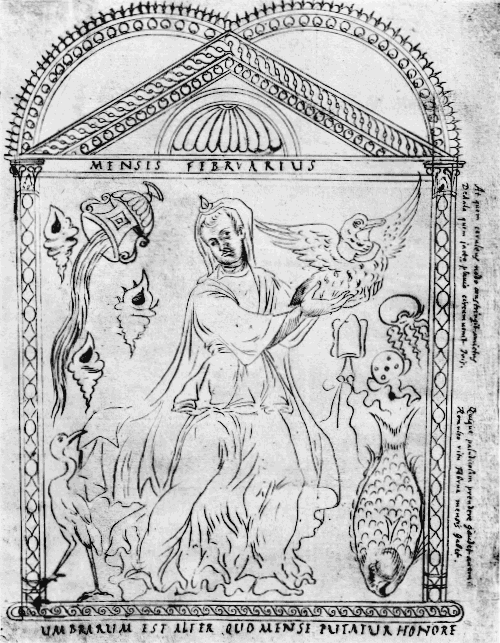
Vatican, Barb. lat. 2154 (Peiresc copy) — February plate
c. 1620The Renaissance facsimile that preserves Filocalus's illustrations and lists; shown, the month of February.
Mommsen, Chronica Minora I (MGH)
1892The critical edition of the calendar and its lists.
Provenance
Rome; a deluxe codex-calendar made for the aristocrat Valentinus
Editions & scholarship
Critical editions and standard translations behind the text above.
- On Roman Time: The Codex-Calendar of 354Michele Renee Salzman, 1990The standard study of the manuscript, its art, and its Christian lists.
- Das Kalenderhandbuch von 354Johannes Divjak & Wolfgang Wischmeyer, 2014Modern two-volume edition and commentary.
Figures named in this text (43)
- Anacletus (Cletus) of Rome
- Evaristus of Rome
- Alexander of Rome
- Xystus I (Sixtus I) of Rome
- Telesphorus of Rome
- Hyginus of Rome
- Pius I of Rome
- Soter of Rome
- Eleutherus of Rome
- Victor I of Rome
- Felicity (Felicitas)
- Vibia Perpetua
- Zephyrinus of Rome
- Callistus I of Rome
- Urban I of Rome
- Hippolytus of Rome
- Pontian of Rome
- Anterus of Rome
- Fabian of Rome
- Moyses of Rome
- Cornelius of Rome
- Lucius I of Rome
- Stephen I of Rome
- Agapitus the Deacon
- Cyprian of Carthage
- Felicissimus the Deacon
- Lawrence (Laurentius) of Rome
- Xystus II (Sixtus II) of Rome
- Dionysius of Rome
- Felix I of Rome
- Eutychian of Rome
- Saint Sebastian
- Caius (Gaius) of Rome
- Gorgonius of Nicomedia
- Agnes of Rome
- Marcellinus of Rome
- Marcellus I of Rome
- Eusebius of Rome
- Sylvester I of Rome
- Pope Mark
- Julius I of Rome
- Liberius of Rome
- Furius Dionysius Filocalus