Primary source · Koine Greek
The Homilies on the Scriptures
John Chrysostom · AD 386–404, Antioch and Constantinople
What this text is
The Golden Mouth verse by verse — ninety homilies on Matthew, the great Romans series with its astonished praise of Junia, and the Statues homilies preached to a city awaiting an emperor's wrath.
Interlinear passages
Word-for-word glosses of the original; the complete public-domain translation is linked below.
Public-domain translations
J. B. Morris & W. H. Simcox, rev. George B. Stevens (NPNF 1st ser. 11, 1889); the Homilies on Acts in the same volume by J. Walker, J. Sheppard & H. Browne, rev. Stevens
To be an apostle is great — but to be of note among the apostles, consider what great praise that is. Oh, how great is the devotion of this woman, that she should be counted worthy of the name of apostle!
Manuscript witnesses
Byzantine homiliary tradition (thousands of copies)
9th c. onwardNo Greek father survives in more manuscripts; the Matthew and Pauline series at the tradition's heart.
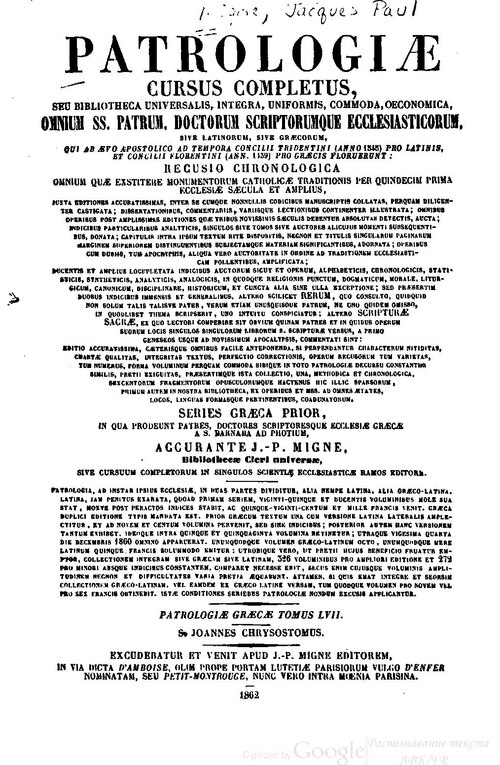
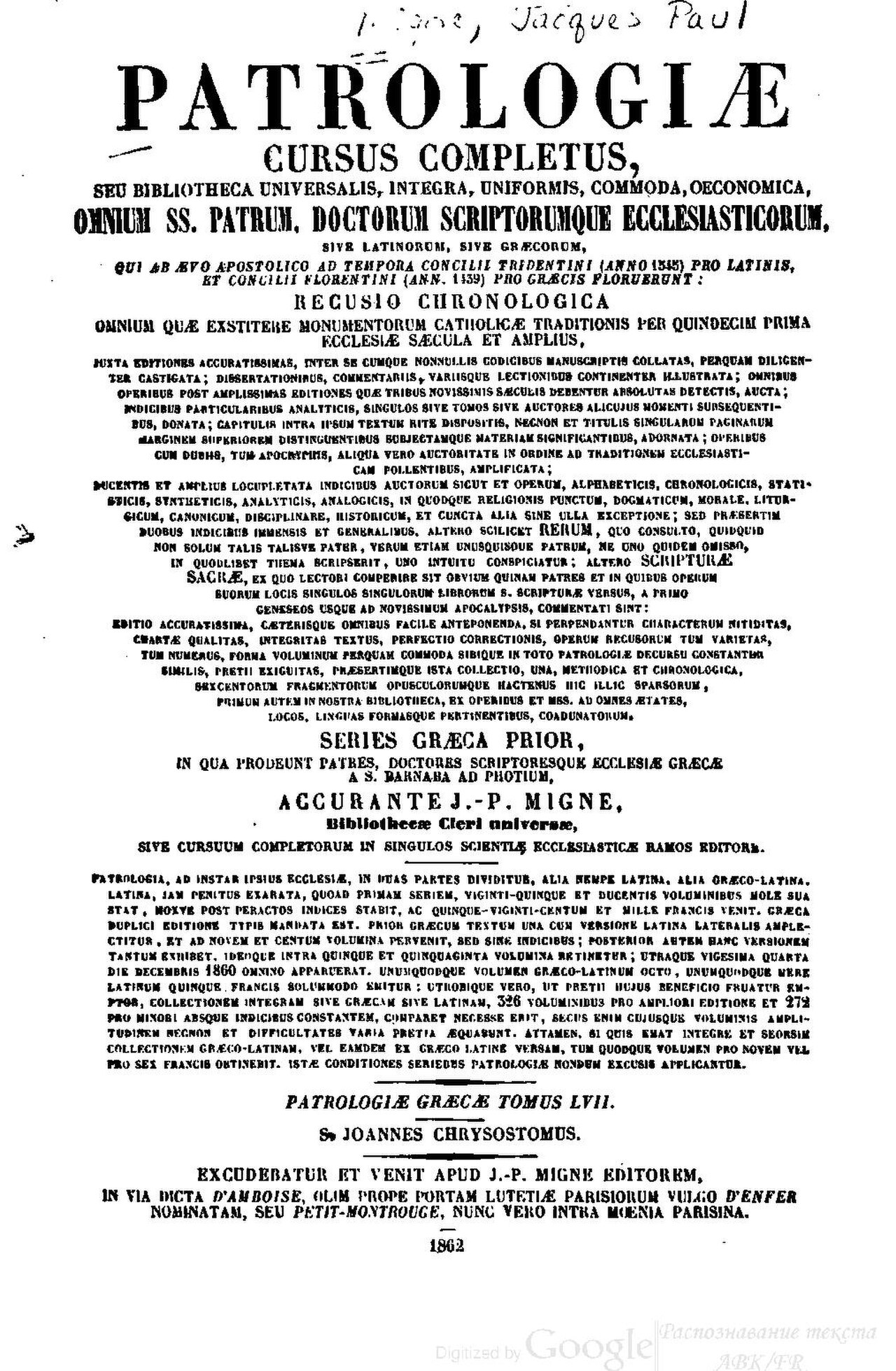
Patrologia Graeca, vol. 57 (Migne)
1860Standard pre-critical text of the corpus.
Provenance
Antioch and Constantinople, AD 386–404 — the largest homiletic corpus of the Greek church.
Chrysostom preached as presbyter at Antioch from 386 until he was made archbishop of Constantinople in the autumn of 397, and the series are assigned between the two cities on internal evidence. The framework is Montfaucon’s, whose Benedictine edition of 1718 worked out most of the attributions still in use: the Matthew homilies were delivered at Antioch, as were the series on 1 Corinthians and the twenty-one Homilies on the Statues, which Montfaucon dated to Lent 387 — the twentieth ten days before Easter, the twenty-first on Easter itself, after Bishop Flavian returned from Rome with the emperor’s pardon. That is eighteenth-century textual scholarship rather than pious guesswork, and it has largely held.
**The fifteen homilies on Philippians are traditionally assigned to Constantinople, and that remains the majority view.** The Nicene and Post-Nicene Fathers editor of the Philippians, Colossians and Thessalonians homilies states it and argues it from the character of the homilies themselves: they are “less complete in exposition than those on earlier books of the New Testament, and in literary excellence will not compare with the Homilies on the Statues, and many other discourses given at Antioch” — because “here at Constantinople the great preacher was burdened with administrative details, and harassed by Court intrigues, so that his sermons were often given with far less than his earlier careful preparation, and seem to have been generally left afterwards to the mercy of shorthand reporters, and of editors who sent them forth when he was in banishment or in the grave.” The reasoning is from evidence: these homilies read differently from the Antiochene sets, and the difference is explained by the difference between the presbyter with time to prepare and the archbishop who had none.
The supporting internal evidence is a passage in the last homily of the series — the long excursus on the misery of kings, in which Chrysostom tells his hearers to look not at the emperor’s diadem “but to his sea of cares,” and closes: “And hath not he who now rules, from the time he received the crown, been in toil, in danger, in grief, in dejection, in misfortune, exposed to conspiracies?” A living emperor, and a preacher near enough to the court to speak of his troubles.
**A note on the other side, so that the reader has the whole picture.** In 1995 Pauline Allen and Wendy Mayer re-examined the series and concluded that the evidence does not settle the question. Their own institution summarises the article’s finding as arguing “that none of the traditional reasons for assigning the homilies to either Antioch or Constantinople stand,” and that it is “possible that some, at least, were delivered at Antioch.” They had earlier shown that the twelve homilies on Colossians contain material from both cities and so are not a single series in the strict sense, and they went on to argue the same of the thirty-four homilies on Hebrews. Two points of theirs are worth having: that “series” may be a shape the manuscript tradition imposed rather than something Chrysostom did on consecutive days; and that the imperial passage will not carry the weight placed on it — a point that goes back to Migne, who observed that its contents were inconsistent with the historical record. The anecdotes it contains (an emperor who exposed his wife to wild beasts, a son blinded from fear of what might follow, a successor poisoned) do not match the reigns they would need to match, and read as general rhetoric rather than reportage they date nothing.
Their conclusion, then, is not that the homilies belong to Antioch. It is that the grounds for placing them anywhere are weaker than has been assumed. **Full argument: Pauline Allen and Wendy Mayer, “Chrysostom and the Preaching of Homilies in Series: A Re-examination of the Fifteen Homilies *In epistulam ad Philippenses* (CPG 4432)”, *Vigiliae Christianae* 49/3 (August 1995), 270–289** — with the companion studies and Mayer’s monograph listed in the bibliography below.
**This archive keeps the traditional attribution.** It is the majority position, it rests on Montfaucon’s framework and on an argument from the homilies’ own character, and the objection to it establishes uncertainty rather than a better answer. Nothing on the pages of the figures named in these homilies — Euodia and Syntyche of Philippi, Syzygus, Epaphroditus — turns on the question: Chrysostom names them in a homily on Philippians, and that is so in either city.
Editions & scholarship
Critical editions and standard translations behind the text above.
- John Chrysostom (The Early Church Fathers)Wendy Mayer & Pauline Allen, 2000Introduction with fresh translations.
- The Homilies on the Gospel of St. Matthew (NPNF I/10)George Prevost, rev. M. B. Riddle, 1888Public-domain English of the Matthew series.
- Homilies on Paul’s Letter to the PhilippiansPauline Allen (trans.), Writings from the Greco-Roman World 16 (SBL, 2013)Greek and English on facing pages; counts sixteen homilies where the Nicene and Post-Nicene Fathers has fifteen. In copyright.
- Chrysostom and the Preaching of Homilies in Series: A Re-examination of the Fifteen Homilies In epistulam ad Philippenses (CPG 4432)Pauline Allen & Wendy Mayer, Vigiliae Christianae 49/3 (August 1995), 270–289The full case that the traditional grounds for assigning these homilies to Antioch or to Constantinople do not stand, and that some at least may have been delivered at Antioch — a claim of uncertainty rather than of relocation. Companions: the twelve Colossians homilies (Orientalia Christiana Periodica 60, 1994, 21–39), the thirty-four on Hebrews (Byzantion 65, 1995, 309–348), and “Traditions of Constantinopolitan preaching” (Byzantinische Forschungen 24, 1997, 93–114). No published rebuttal was located.
- The Homilies of St John Chrysostom: Provenance. Reshaping the FoundationsWendy Mayer, Orientalia Christiana Analecta 273 (Rome, 2005)The programme in full — a 1996 University of Queensland dissertation revised into a monograph, reassessing where Chrysostom preached what.
Figures named in this text (61)
- Ananias of Jerusalem
- Sapphira
- Tabitha (Dorcas)
- Aeneas of Lydda
- Ananias of Damascus
- Elymas (Bar-Jesus)
- Simon the Tanner
- Mary, Mother of John Mark
- Rhoda
- Demetrius the Silversmith
- Cornelius the Centurion
- Lydia of Thyatira
- Euodia of Philippi
- Syntyche of Philippi
- Syzygus (“True Yokefellow”)
- Epaphroditus
- Zenas the Lawyer
- Achaicus of Corinth
- Carpus of Troas
- Phoebe of Cenchreae
- Stephanas of Corinth
- The Mother of Rufus
- Aquila of Pontus
- Eutychus of Troas
- Prisca (Priscilla)
- Apphia of Colossae
- Epaenetus
- Timon the Deacon
- Mary of Rome
- Andronicus
- Junia
- Ampliatus
- Urbanus
- Apelles
- Stachys
- Herodion
- The Household of Aristobulus
- Nicanor the Deacon
- Prochorus the Deacon
- The Household of Narcissus
- Tryphaena
- Tryphosa
- Persis
- Asyncritus
- Phlegon
- Hermes of Rome
- Patrobas
- Hermas of Romans 16
- Julia
- Philologus
- Nereus and His Sister
- Tertius the Scribe
- Apollos of Alexandria
- Olympas
- Quartus the Brother
- Fortunatus of Corinth
- Parmenas the Deacon
- Philogonius of Antioch
- John Chrysostom
- Chloe of Corinth
- Onesiphorus of Ephesus