The Nicene Age · AD 313–400
Melania the Elder
c. AD 341 – c. 410 (held at the timeline's ceiling) · Roman patrician · Founder on the Mount of Olives · Rome → Nitria → Jerusalem
The Nicene Age

Who Melania the Elder was
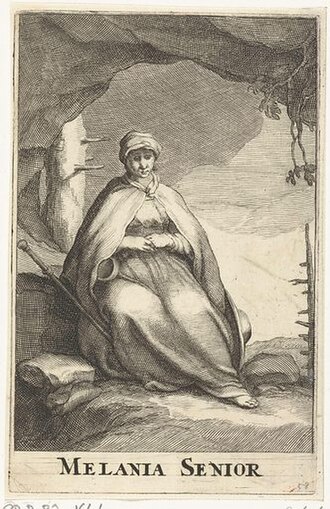
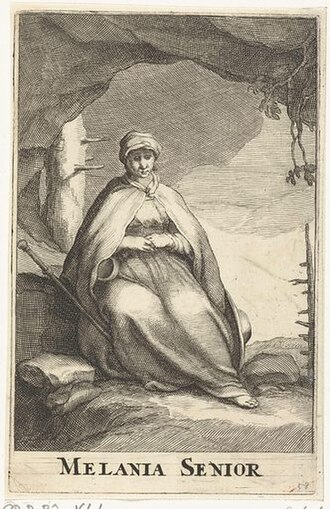
Grandest of the Roman ascetic widows: she carried her fortune to the desert (supporting the exiled confessors from her own purse), followed them to Palestine, and built the double monastery on the Mount of Olives with Rufinus — grandmother and recruiter of Melania the Younger. Palladius calls her 'the female man of God.'
Also listed in women.
Common questions
When did Melania live?
Melania the Elder is dated c. AD 341 – c. 410 (held at the timeline's ceiling) in the archive, which places Melania in the Nicene Age (AD 313–400). The dating is traditional and approximate; the archive marks it as uncertain rather than fixing a year the sources do not give.
Which early sources mention Melania?
Melania the Elder is named in 3 primary-source passages catalogued here, drawn from Jerome of Stridon, Paulinus of Nola and Palladius of Galatia. Every passage is quoted from a named public-domain translation, earliest first.
Where was Melania from?
The archive associates Melania the Elder with Rome, Nitria, Jerusalem. The sources record more than one location, so the places are listed in the order the record moves through them.
Who were Melania’s contemporaries?
The archive links Melania the Elder to 3 other figures, including Pambo of Nitria, Isidore the Hosteller and Jerome of Stridon. Each connection is drawn from a source that places them together, not from inference.
Primary-source mentions (3)
Every passage below is quoted from a named public-domain translation, earliest first.
Letter 3.3 (the young Jerome's 'new Thecla')
c. AD 374Paulinus of Nola, Letter 29.5–14 (the kinsman's full portrait of the pilgrim grandmother)
c. AD 400[Paulinus, her kinsman, gives the fullest surviving portrait of Melania the Elder — her pilgrimage, her years in Jerusalem, and her return through Nola.]Paulinus of Nola · Paulinus of Nola, Epistle 29.5–14
The letters of Paulinus of Nola, written between c. AD 394 and 423 and the chief record of the western ascetic circle around him. Critical text: Wilhelm von Hartel, Corpus Scriptorum Ecclesiasticorum Latinorum 29 (1894); English translation by P. G. Walsh, Ancient Christian Writers 35–36 (1966–67). No public-domain English translation exists.
Lausiac History 46
c. AD 420When the exiles were sent to Palestine, she followed them and ministered to them from her own treasures… The most blessed Melania, that female man of God, founded a monastery in Jerusalem, and lived there twenty-seven years.Palladius of Galatia · 46 · source text
Connected in the archive
People
Events in this lifetime
- AD 339 · The persecution of Shapur II, AD 339
- AD 343 · The Council of Serdica, AD 343
- AD 361 · Julian’s pagan restoration, AD 361
- AD 366 · Damasus and the catacomb epigrams, AD 366
- AD 367 · Athanasius lists the 27 NT books, AD 367
- AD 372 · The martyrdom of Sabbas the Goth, AD 372
- AD 378 · Queen Mavia’s revolt, AD 378
- AD 380 · The Edict of Thessalonica, AD 380
- AD 381 · The Council of Constantinople, AD 381
- AD 381 · The Council of Aquileia, AD 381
- AD 384 · The Altar of Victory petition, AD 384
- AD 390 · Thessalonica and the penance of Theodosius, AD 390
- AD 397 · Carthage confirms the canon, AD 397
Place
Places served
The 4 places the sources put Melania, in the order the record moves through them. This is what the sources attest, not a reconstructed route.
- 1RomeA Roman noblewoman of the gens AntoniaPalladius, Lausiac History 46
- 2AlexandriaSailed to Egypt after her husband’s deathPalladius, Lausiac History 46
- 3NitriaSpent six months among the monks of NitriaPalladius, Lausiac History 46
- 4JerusalemFounded a monastery on the Mount of Olives with RufinusPalladius, Lausiac History 46