The Nicene Age · AD 313–400
Siricius of Rome
d. 399 · Bishop of Rome · First issuer of decretals · Rome
The Nicene Age
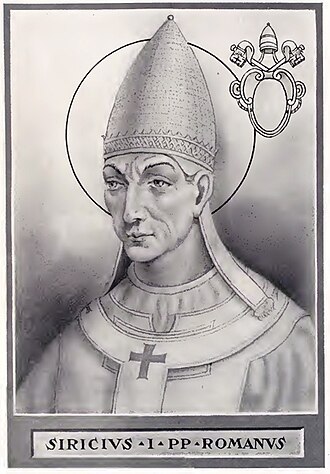
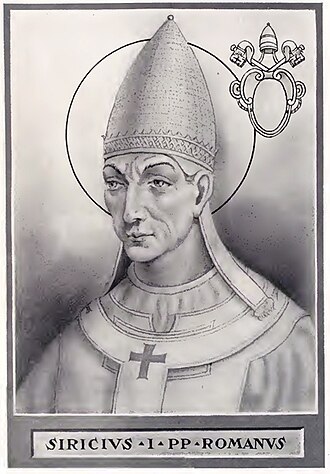

Who Siricius of Rome was
Bishop of Rome (384–399), successor of Damasus, remembered as the first pope whose authoritative letters — decretals — survive, framed in the imperial style of rescripts and claiming for Rome a legislative voice over the Western churches. His letter to Himerius of Tarragona (385), the earliest such decretal, ruled on baptism, penance, and clerical celibacy. He condemned the heretic Jovinian and confirmed the sentence against the Priscillianists. With Siricius the papacy begins to speak in the settled language of law rather than exhortation.
Also listed in the bishops of Rome.
Common questions
When did Siricius die?
Siricius of Rome is dated d. 399 in the archive, which places Siricius in the Nicene Age (AD 313–400).
What did Siricius write?
Siricius of Rome has 1 catalogued writing in the archive: Letter to Himerius of Tarragona (the first decretal).
Which early sources mention Siricius?
Siricius of Rome is named in 2 primary-source passages catalogued here, drawn from Paulinus of Nola and Latin canonical tradition. Every passage is quoted from a named public-domain translation, earliest first.
Where was Siricius from?
The archive associates Siricius of Rome with Rome.
Writings (1)
Letter to Himerius of Tarragona (the first decretal)
AD 385We bear the burdens of all who are heavy laden; nay, rather the blessed Apostle Peter bears them in us, who, as we trust, protects and guards us in all things as the heirs of his office.Read the interlinear source text →
Primary-source mentions (2)
Every passage below is quoted from a named public-domain translation, earliest first.
Paulinus of Nola, Letter 5.14 (the pope's cold reception remembered)
c. AD 396[Paulinus recalls the coldness with which Rome received him, and names Siricius as the bishop of the day.]Paulinus of Nola · Paulinus of Nola, Epistle 5.14
The letters of Paulinus of Nola, written between c. AD 394 and 423 and the chief record of the western ascetic circle around him. Critical text: Wilhelm von Hartel, Corpus Scriptorum Ecclesiasticorum Latinorum 29 (1894); English translation by P. G. Walsh, Ancient Christian Writers 35–36 (1966–67). No public-domain English translation exists.
On Illustrious Men (continued) & the decretal tradition
c. AD 500Siricius, bishop of the Roman church, sent authoritative replies to the bishops of Spain, Gaul, and Africa, which the churches received as rules of discipline.Latin canonical tradition · source text
Connected in the archive
People
Events in this lifetime
- AD 339 · The persecution of Shapur II, AD 339
- AD 343 · The Council of Serdica, AD 343
- AD 361 · Julian’s pagan restoration, AD 361
- AD 366 · Damasus and the catacomb epigrams, AD 366
- AD 367 · Athanasius lists the 27 NT books, AD 367
- AD 372 · The martyrdom of Sabbas the Goth, AD 372
- AD 378 · Queen Mavia’s revolt, AD 378
- AD 380 · The Edict of Thessalonica, AD 380
- AD 381 · The Council of Constantinople, AD 381
- AD 381 · The Council of Aquileia, AD 381
- AD 384 · The Altar of Victory petition, AD 384
- AD 390 · Thessalonica and the penance of Theodosius, AD 390
- AD 397 · Carthage confirms the canon, AD 397
Place
Places served
The one place the sources put Siricius.
- 1Rome