The Nicene Age · AD 313–400
Damasus I of Rome
d. 384 · Bishop of Rome · Patron of Jerome · Rome
The Nicene Age
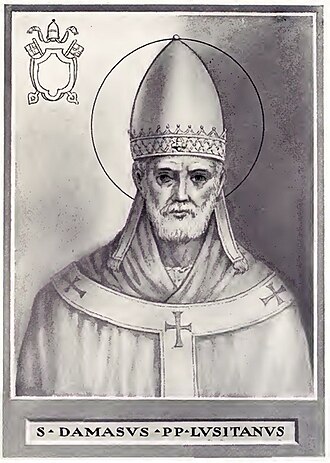
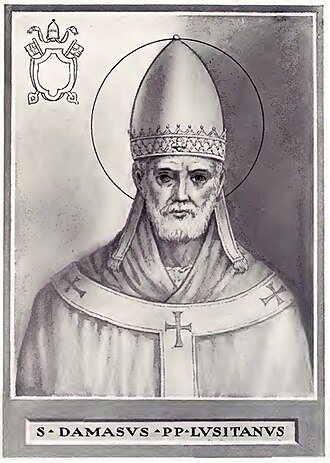

Who Damasus I of Rome was
Bishop of Rome (366–384) whose reign, after a bloody contested election, set the papacy on a new footing of prestige: he championed Roman primacy, held synods condemning Arianism and Apollinarianism, and secured from Theodosius the recognition of Nicene Christianity as the state religion. A cultivated patron, he commissioned his secretary Jerome to revise the Latin Gospels — the seed of the Vulgate — and adorned the martyrs’ tombs in the catacombs with elegant verse epitaphs cut in a beautiful new script. He turned Rome’s past into a monument and its faith into an imperial establishment.
Also listed in the bishops of Rome.
Common questions
When did Damasus I die?
Damasus I of Rome is dated d. 384 in the archive, which places Damasus I in the Nicene Age (AD 313–400).
What did Damasus I write?
Damasus I of Rome has 2 catalogued writings in the archive: Epigrammata (verse epitaphs for the martyrs) and The Epigrams (some sixty verse inscriptions for the Roman martyrs).
Which early sources mention Damasus I?
Damasus I of Rome is named in 5 primary-source passages catalogued here, drawn from Damasus of Rome, Jerome of Stridon, Siricius of Rome and Ammianus Marcellinus. Every passage is quoted from a named public-domain translation, earliest first.
Where was Damasus I from?
The archive associates Damasus I of Rome with Rome.
Writings (2)
Epigrammata (verse epitaphs for the martyrs)
c. 366–384Here, if you ask, lies heaped a throng of the righteous… Damasus confesses he wished to lay his own limbs here, but feared to disturb the holy ashes of the saints.Read the interlinear source text →
The Epigrams (some sixty verse inscriptions for the Roman martyrs)
AD 366–384[Composed by Damasus, cut by Filocalus, and set at the martyrs’ tombs throughout the Roman catacombs.]Read the interlinear source text →
Primary-source mentions (5)
Every passage below is quoted from a named public-domain translation, earliest first.
The Damasan epigram the corpus of some sixty epigrams cut at his order between 366 and 384, cut by Furius Dionysius Filocalus
c. AD 375[Damasus set a verse epitaph at this tomb; the epigram is an epigraphic attestation additional to the literary record.]Damasus of Rome · Damasan epigram, the corpus of some sixty epigrams cut at his order between 366 and 384 · source text
Letter 15 (Jerome to Damasus: 'I speak with the successor of the fisherman')
c. AD 376My words are spoken to the successor of the fisherman, to the disciple of the cross.Jerome of Stridon · Letter 15 · source text
Decretal to Himerius (Siricius invokes 'my predecessor of venerable memory')
c. AD 385Res Gestae XXVII.3 (the bloody election of 366, by the pagan historian)
c. AD 390It is certain that on one day one hundred and thirty-seven corpses of slain persons were found in the basilica of Sicininus.Ammianus Marcellinus · Res Gestae XXVII.3 · source text
Preface to the Gospels (to Damasus)
c. AD 393You urge me to make a new work out of an old, and to sit in judgment on the copies of the Scriptures now scattered throughout the world… a pious labour, but a perilous presumption.Jerome · source text
Connected in the archive
People
- Jerome of Stridon
- Liberius of Rome
- Siricius of Rome
- Ambrose of Milan
- Tarcisius the Acolyte
- Agnes of Rome
- Marcellus I of Rome
- Peter II of Alexandria
- Paulinus of Antioch
- Pacian of Barcelona
- Furius Dionysius Filocalus
- Prudentius
- Tarsicius
- Eutychius the Martyr
- Felicissimus the Deacon
- Agapitus the Deacon
- Faustinus of the Generosa epigram
- Viatrix
- Irene
- Verus the Presbyter
- Nereus of Domitilla
- Achilleus of Domitilla
Named alongside Damasus I in the sources
This figure is placed with Damasus I by the record — in a council roll, a martyr-act, a letter or a history — without Damasus I naming them in return.
Events in this lifetime
- AD 314 · The Council of Arles, AD 314
- AD 320 · Silvanus tried before Zenophilus, AD 320
- AD 325 · The Council of Nicaea, AD 325
- AD 339 · The persecution of Shapur II, AD 339
- AD 343 · The Council of Serdica, AD 343
- AD 361 · Julian’s pagan restoration, AD 361
- AD 366 · Damasus and the catacomb epigrams, AD 366
- AD 367 · Athanasius lists the 27 NT books, AD 367
- AD 372 · The martyrdom of Sabbas the Goth, AD 372
- AD 378 · Queen Mavia’s revolt, AD 378
- AD 380 · The Edict of Thessalonica, AD 380
- AD 381 · The Council of Constantinople, AD 381
- AD 381 · The Council of Aquileia, AD 381
- AD 384 · The Altar of Victory petition, AD 384
Place
Places served
The one place the sources put Damasus I.
- 1Rome